Today's
EarthStation1.com 15% Off Commemorative Memorial Title: The
Colosseum: Rome's Flavian Amphitheatre Coliseum DVD MP4 USB Drive
Today, November 17, 2025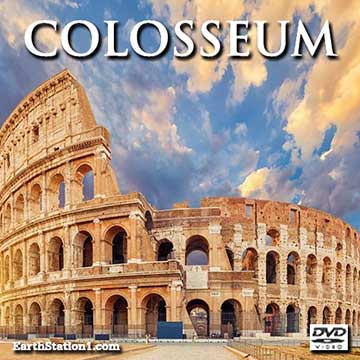
November 17, 9 AD: #BOTD: #HBD: Vespasian
(Latin: Vespasianus), Roman Emperor, renown for his military
success and for initiating construction of The Colosseum (d. June
23-24, 79) is #born Titus Flavius Vespasianus in a village
north-east of Rome called Falacrinae. His family was relatively
undistinguished and lacking in pedigree. Vespasian was Roman
emperor from 69 to 79. The fourth and last in the Year of the Four
Emperors, he founded the Flavian dynasty that ruled the Empire for
27 years. Vespasian was the first emperor from an equestrian
family and only rose into the senatorial rank as the first member
of his family later in his lifetime. He was legate (Latin:
legatus, a high-ranking Roman military officer in the Roman Army
equivalent to general) of Legio II Augusta (Latin: Second Legion
Augustus") during the Roman invasion of Britain in 43 AD, and
he subjugated Judaea during the Jewish Rebellion of 66 AD. While
Vespasian besieged Jerusalem during the Jewish rebellion, emperor
Nero committed suicide and plunged Rome into a year of civil war
known as the Year of the Four Emperors. After Galba and Otho
perished in quick succession, Vitellius became emperor in April
69. The Roman legions of Roman Egypt and Judaea reacted by
declaring Vespasian, their commander, the emperor on July 1, 69.
In his bid for imperial power, Vespasian joined forces with
Mucianus, the governor of Syria, and Primus, a general in
Pannonia, leaving his son Titus to command the besieging forces at
Jerusalem. Primus and Mucianus led the Flavian forces against
Vitellius, while Vespasian took control of Egypt. On December 20,
69, Vitellius was defeated, and the following day Vespasian was
declared emperor by the Senate. Little information survives about
the government during Vespasian's ten-year rule. He reformed the
financial system of Rome after the campaign against Judaea ended
successfully, and initiated several ambitious construction
projects, including the building of the Flavian Amphitheatre,
better known today as the Roman Colosseum. Through his general
Agricola, Vespasian increased imperial expansion in Britain.
Vespasian is often credited with restoring political stability to
Rome following the chaotic reigns of his predecessors. After he
died in 79, he was succeeded by his eldest son Titus, thus
becoming the first Roman emperor to be succeeded by his natural
son and establishing the Flavian dynasty. Vespasian died of acute
diarrhea on a visit to the Aquae Cutiliae, a mineral spring in
Italy near the modern Cittaducale, central Italy, aged 69. He was
buried at The Mausoleum Of Augustus, Rome, Italy. On Sale @ 15%
Off Discount Till Midnight PT!
https://store.earthstation1.com/the-colosseum-rome39s-flavian-amphitheatre-coliseum-dvd-mp4-usb-dr394.html
Today's
EarthStation1.com 15% Off Commemorative Memorial Title: Pirates 12
Part Documentary Series MP4 Video Download DVD
Today, November 17, 2025
November 17, 1558: The English Monarchy
(The Monarchy Of The Kingdom Of England): Royal Accessions:
Successions To The English, Scottish And Irish Thrones: -- The
Elizabethan era begins as Elizabeth I Of England succeeds to the
throne after her half-sister Queen Mary I Of England dies. Queen
Elizabeth I, Queen Of England and Ireland from November 17, 1558
until her death (September 7, 1533 - March 24, 1603) was born in
the Palace of Placentia. also known as Greenwich Palace. Elizabeth
I was sometimes called The Virgin Queen, Gloriana or Good Queen
Bess. Some have suggested that she was the mother of Edward de
Vere, 17th Earl Of Oxford, who was a favorite in Elizabeth's court
and who those who subscribe to the Oxfordian theory of
Shakespearean authorship believe was the true identity of William
Shakespeare. Whether she was or was not his mother, history
officially records that Elizabeth was childless, and thereby was
the last monarch of the House of Tudor. She was the daughter of
King Henry VIII and Anne Boleyn. She ascended the throne in 1558
at age 25. During her reign, Britain became a world power by
defeating the Spanish Armada. The Anglican Church was also fully
established. On Sale @ 15% Off Discount Till Midnight PT!
https://store.earthstation1.com/pirates-12-part-documentary-series-mp4-video-download-124.html
Today's
EarthStation1.com 15% Off Commemorative Memorial Title: Armada:
Spanish Armada TV Series + Bonus MP4 Video Download DVD
Today, November 17, 2025
November 17, 1603: The English Monarchy
(The Monarchy Of The Kingdom Of England): English Political
Conspiracies: The Main Plot: -- Sir Walter Raleigh, English
explorer, writer and courtie, goes on trial for treason for his
alleged involvement in the Main Plot, an alleged conspiracy of
July 1603, supposedly led by Lord Henry Brooke, 11th Baron Cobham
and funded by the Spanish government, to remove King James I from
the English throne and to replace him with his cousin Lady Arbella
Stuart. Raleigh had been arrested on July 19, 1603 at what is now
the Old Exeter Inn in Ashburton, charged with treason, and his
trial began on November 17 in the converted Great Hall of
Winchester Castle. Raleigh conducted his own defence. The chief
evidence against him was the signed and sworn confession of his
friend Lord Brooke. Raleigh repeatedly requested that Cobham be
called to testify, but the tribunal refused to allow Cobham either
to testify or be cross-examined; despite this refusal, Raleigh's
trial has been regularly cited as influential in establishing a
common law right to confront accusers in court. Raleigh was
convicted, but King James spared his life. While imprisoned in the
Tower, Raleigh wrote his incomplete The History of the World.
Using a wide array of sources in six languages, Raleigh was fully
abreast of the latest continental scholarship. He wrote not about
England, but of the ancient world with a heavy emphasis on
geography. First published in 1614, it covers the course of human
history from Genesis to the conquest of Macedon by Rome. Raleigh
intended to write more volumes relating the rise and fall of the
great empires, but his release in 1615, his expedition to Guiana,
and his execution in 1618, prevented the accomplishment of his
plan. According to Edmund Gosse, "This huge composition is
one of the principal glories of seventeenth-century literature,
and takes a very prominent place in the history of English prose."
Despite Raleigh's intention of providing current advice to the
King Of England, King James I complained that it was "too
sawcie in censuring Princes". Raleigh remained imprisoned in
the Tower until March 20, 1616. His son, Carew, was conceived and
born (in 1604 or 1605) while Raleigh was imprisoned in the Tower.
In 1617, Raleigh was pardoned by the King and granted permission
to conduct an ill-fated second expedition to Venezuela in search
of El Dorado. Sir Walter Raleigh, English statesman, soldier,
writer and explorer, one of the most notable figures of the
Elizabethan era, who played a leading part in English colonisation
of North America, suppressed rebellion in Ireland, helped defend
England against the Spanish Armada and held political positions
under Elizabeth I (c. 1552 - October 29, 1618) was born to a
landed gentry family of Protestant faith in East Budleigh, Devon,
England, the son of Walter Raleigh and Catherine Champernowne. He
was the younger half-brother of Sir Humphrey Gilbert and a cousin
of Sir Richard Grenville. Little is known of his early life,
though in his late teens he spent some time in France taking part
in the religious civil wars. In his 20s he took part in the
suppression of rebellion in the colonisation of Ireland; he also
participated in the siege of Smerwick. Later, he became a landlord
of property in Ireland and mayor of Youghal in East Munster, where
his house still stands in Myrtle Grove. He rose rapidly in the
favour of Queen Elizabeth I and was knighted in 1585. He was
granted a royal patent to explore Virginia, paving the way for
future English settlements. In 1591, he secretly married Elizabeth
Throckmorton, one of the Queen's ladies-in-waiting, without the
Queen's permission, for which he and his wife were sent to the
Tower of London. After his release, they retired to his estate at
Sherborne, Dorset. Walter Raleigh died of beheading in the Old
Palace Yard at the Palace of Westminster in London, England aged
approximately 65 for allegedly conspiring against James I of
England, but actually to appease England's hitherto enemy, Spain.
After Queen Elizabeth died in 1603, Raleigh was imprisoned (again)
in The Tower Of London, this time for being involved in the Main
Plot against King James I, who was not favourably disposed towards
him. In 1616, he was released to lead a second expedition in
search of El Dorado; in 1594, Raleigh heard of a "City of
Gold" in South America and sailed to find it, publishing an
exaggerated account of his experiences in a book that contributed
to the legend of "El Dorado". During the expedition, a
detachment of Raleigh's men led by his top commander and long-time
friend Lawrence Kemys attacked the Spanish outpost of Santo Tome
de Guayana on the Orinoco river, in violation of peace treaties
with Spain and against Raleigh's orders. A condition of Raleigh's
pardon was avoidance of any hostility against Spanish colonies or
shipping. In the initial attack on the settlement, Raleigh's son,
Walter, was fatally shot. Kemys informed Raleigh of his son's
death and begged for forgiveness, but did not receive it, and at
once committed suicide. On Raleigh's return to England, an
outraged Count Gondomar, the Spanish ambassador, demanded that
Raleigh's death sentence be reinstated by King James, who had
little choice but to do so. Raleigh was brought to London from
Plymouth by Sir Lewis Stukley, where he passed up numerous
opportunities to make an effective escape. "Let us dispatch",
he said to his executioner. "At this hour my ague (fever)
comes upon me. I would not have my enemies think I quaked from
fear." After he was allowed to see the axe that would be used
to behead him, he mused: "This is a sharp Medicine, but it is
a Physician for all diseases and miseries." According to
biographers, Raleigh's last words, spoken to the hesitating
executioner, were: "What dost thou fear? Strike, man,
strike!" Having been one of the people to popularise tobacco
smoking in England, he left a small tobacco pouch, found in his
cell shortly after his execution. Engraved upon the pouch was a
Latin inscription: Comes meus fuit in illo miserrimo tempore ("It
was my companion at that most miserable time"). Raleigh's
head was embalmed and presented to his wife. His body was to be
buried in the local church in Beddington, Surrey, the home of Lady
Raleigh, but was finally laid to rest in St. Margaret's,
Westminster, where his tomb is presently located. "The
Lords", she wrote, "have given me his dead body, though
they have denied me his life. God hold me in my wits." It has
been said that Lady Raleigh kept her husband's head in a velvet
bag until her death. After Raleigh's wife's death 29 years later,
his head was removed to his tomb and interred at St. Margaret's
Church. Although Raleigh's popularity had waned considerably since
his Elizabethan heyday, his execution was seen by many, both at
the time and since, as unnecessary and unjust, as for many years
his involvement in the Main Plot seemed to have been limited to a
meeting with Lord Cobham. One of the judges at his trial later
said: "The justice of England has never been so degraded and
injured as by the condemnation of the honourable Sir Walter
Raleigh." On Sale @ 15% Off Discount Till Midnight PT!
https://store.earthstation1.com/armada-dvd-spanish-armada-tv-series-all-3-episode3.html
Today's
EarthStation1.com 15% Off Commemorative Memorial Title:
Washington, D.C. History Video Set DVD, MP4 Download, USB Flash
Drive
Today, November 17, 2025
November 17, 1800: The United States: The
History Of The United States: The Federal Government Of The United
States (The U.S. Federal Government, The U.S. Government): The 6th
United States Congress: -- The U.S. Congress met for the first
time in the new United States Capitol Building in Washington,
D.C.. The 6th United States Congress was a meeting of the
legislative branch of the United States federal government,
consisting of the United States Senate and the United States House
Of Representatives, that first met at Congress Hall in
Philadelphia, Pennsylvania and later, for the first time, in
Washington, D.C., a session that ran from March 4, 1799, to March
4, 1801, during the last two years of John Adams's presidency. It
was the last Congress of the 18th century and the first to convene
in the 19th. The apportionment of seats in House of
Representatives was based on the First Census of the United States
in 1790. Both chambers had a Federalist majority. This was the
last Congress in which the Federalist Party controlled the
presidency or either chamber of Congress. On Sale @ 15% Off
Discount Till Midnight PT!
https://store.earthstation1.com/washington-dc-history-videos-dvd-mp4-download-usb-driv4.html
Today's
EarthStation1.com 15% Off Commemorative Memorial Title: The World:
A Television History Documentary Series DVD, Download, USB
Today, November 17, 2025
November 17, 1869: Engineering:
Engineering Projects: Multinational Engineering Projects: The Suez
Canal (Arabic: Qanat As-Suwais): -- The Mediterranean Sea is
linked for the first time, via a single artificial sea-level
waterway, with the Red Sea through the Isthmus Of Suez which
divides Africa and Asia (and by extension, the Sinai Peninsula
from the rest of Egypt) as The Suez Canal is inaugurated. The
193.30-kilometre-long (120.11 mi) canal is a key trade route
between Europe and Asia. In 1858, French diplomat Ferdinand de
Lesseps formed the Compagnie de Suez for the express purpose of
building the canal. Construction of the canal lasted from 1859 to
1869. The canal officially opened on 17 November 1869. It offers
vessels a direct route between the North Atlantic and northern
Indian oceans via the Mediterranean Sea and the Red Sea, avoiding
the South Atlantic and southern Indian oceans and reducing the
journey distance from the Arabian Sea to London by approximately
8,900 kilometres (5,500 mi), to 10 days at 20 knots (37 km/h; 23
mph) or 8 days at 24 knots (44 km/h; 28 mph). The canal extends
from the northern terminus of Port Said to the southern terminus
of Port Tewfik at the city of Suez. In 2021, more than 20,600
vessels traversed the canal (an average of 56 per day). The
original canal featured a single-lane waterway with passing
locations in the Ballah Bypass and the Great Bitter Lake. It
contained, according to Alois Negrelli's plans, no locks, with
seawater flowing freely through it. In general, the water in the
canal north of the Bitter Lakes flows north in winter and south in
summer. South of the lakes, the current changes with the tide at
Suez. On October 29, 1888, The United Kingdom, Germany,
Austria-Hungary, Spain, France, Italy, the Netherlands, the
Russian Empire, and the Ottoman Empire signed The Convention Of
Constantinople, which guaranteeed free maritime passage through
the Suez Canal during War And Peace. The Khedivate of Egypt,
through whose territory the Canal ran, and to whom all shares in
the Suez Canal Company were due to revert when the company's
99-year lease to manage the Canal expired, was not invited to
participate in the negotiations, and did not sign the treaty. The
canal was the property of the Egyptian government, but European
shareholders, mostly British and French, owned the concessionary
company which operated it until July 1956, when President Gamal
Abdel Nasser nationalised it-an event which led to the Suez Crisis
of October-November 1956. The canal is operated and maintained by
the state-owned Suez Canal Authority (SCA) of Egypt. Under the
Convention of Constantinople, it may be used "in time of war
as in time of peace, by every vessel of commerce or of war,
without distinction of flag." Nevertheless, the canal has
played an important military strategic role as a naval short-cut
and choke point. Navies with coastlines and bases on both the
Mediterranean Sea and the Red Sea (Egypt and Israel) have a
particular interest in the Suez Canal. After Egypt closed the Suez
Canal at the beginning of the Six-Day War on 5 June 1967, the
canal remained closed for eight years, reopening on 5 June 1975.
The Egyptian government launched construction in 2014 to expand
and widen the Ballah Bypass for 35 km (22 mi) to speed up the
canal's transit time. The expansion intended to nearly double the
capacity of the Suez Canal, from 49 to 97 ships per day. At a cost
of LE 59.4b (9b USD), this project was funded with
interest-bearing investment certificates issued exclusively to
Egyptian entities and individuals. The Suez Canal Authority
officially opened the new side channel in 2016. This side channel,
at the northern side of the east extension of the Suez Canal,
serves the East Terminal for berthing and unberthing vessels from
the terminal. As the East Container Terminal is located on the
Canal itself, before the construction of the new side channel it
was not possible to berth or unberth vessels at the terminal while
a convoy was running. On Sale @ 15% Off Discount Till Midnight PT!
https://store.earthstation1.com/the-world-a-television-history-4-dual-layer-dvds-all-26-sh426.html
Today's
EarthStation1.com 15% Off Commemorative Memorial Title: Monty:
Bernard Montgomery Documentaries DVD, Video Download, USB Drive
Today, November 17, 2025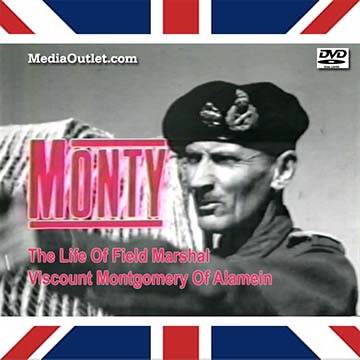
November 17, 1887: #BOTD: #HBD! Bernard
Montgomery, English field marshal, nicknamed "Monty" and
the "Spartan General" (d. March 24, 1976) is #born
Bernard Law Montgomery in Kennington, Surrey, England. Bernard Law
Montgomery, 1st Viscount Montgomery Of Alamein, KG, GCB, DSO, PC,
DL, 1st Viscount Montgomery of Alamein, fought in both the First
World War and the Second World War. He saw action in the First
World War as a junior officer of the Royal Warwickshire Regiment.
At Meteren, near the Belgian border at Bailleul, he was shot
through the right lung by a sniper, during the First Battle Of
Ypres. He returned to the Western Front as a general staff officer
and took part in the Battle of Arras in April/May 1917. He also
took part in the Battle Of Passchendaele in late 1917 before
finishing the war as Chief Of Staff of the 47th (2nd London)
Division. In the inter-war years he commanded the 17th (Service)
Battalion, Royal Fusiliers and, later, the 1st Battalion, Royal
Warwickshire Regiment before becoming commander of 9th Infantry
Brigade and then General Officer Commanding (GOC) 8th Infantry
Division. During the Second World War he commanded the British
Eighth Army from August 1942 in the Western Desert until the final
Allied victory in Tunisia in May 1943. This command included the
Second Battle Of El Alamein, a turning point in the Western Desert
Campaign. He subsequently commanded the British Eighth Army during
the Allied invasion of Sicily and the Allied invasion of Italy. He
was in command of all Allied ground forces during Operation
Overlord from the initial landings until after the Battle of
Normandy. He then continued in command of the 21st Army Group for
the rest of the campaign in North West Europe. As such he was the
principal field commander for the failed airborne attempt to
bridge the Rhine at Arnhem, and the Allied Rhine crossing. On May
4, 1945 he took the German surrender at Luneburg Heath in Northern
Germany. After the war he became Commander-In-Chief of the British
Army of the Rhine (BAOR) in Germany and then Chief of the Imperial
General Staff (1946-1948). He then served as Deputy Supreme
Commander of NATO in Europe until his retirement in 1958.
Montgomery died at his home Isington Mill in Isington, Hampshire,
aged 88. After a funeral at St George's Chapel, Windsor, his body
was buried in Holy Cross churchyard, in Binsted, Hampshire. On
Sale @ 15% Off Discount Till Midnight PT!
https://store.earthstation1.com/montgomery-dvd-field-marshal-bernard-law-dual-layer-wwii.html
Today's
EarthStation1.com 15% Off Commemorative Memorial Title: The
President Vanishes (1934) DVD, Video Download, USB Flash Drive
Today, November 17, 2025
November 17, 1934: Aesthetics: Performing
Arts: Premieres: Film Premieres: American Film Premieres: -- The
film The President Vanishes is released, an American political
drama film directed by William A. Wellman and produced by Walter
Wanger. Starring Edward Arnold and Arthur Byron, the film is an
adaptation of the controversial 1934 anonymous political novel
published one month prior of the same name (revealed in 1938 to
have been written by detective fiction wroter Rex Stout). Upon the
release of the film, the National Legion of Decency - an
organization of the United States Catholic Church - named it as
one of Hollywood's problematic and "immoral" films. Both
book and film are based on the events of the failed Business Plot,
also called the Wall Street Putsch, The White House Putsch and The
White House Coup Of 1934, a political conspiracy in 1933 in the
United States to overthrow the government of President Franklin D.
Roosevelt and install a fascist dictator. The existence of the
plot was testified to by two-time Medal Of Honor recipient Smedley
Butler before the United States House Of Representatives Special
Committee On Un-American Activities (the "McCormack-Dickstein
Committee"), events that occurred in the very same year this
esteemed political drama and the film based on it were released.
Retired Marine Corps Major General Smedley Butler asserted that
wealthy businessmen were plotting to create a fascist veterans'
organization with Butler as its leader and use it in a coup d'etat
to overthrow Roosevelt. In 1934, Butler testified under oath
before the United States House Of Representatives Special
Committee on Un-American Activities (the "McCormack-Dickstein
Committee") on these revelations. No one was prosecuted. At
the time of the incidents, most major news media dismissed the
plot, with a New York Times editorial characterizing it as a
"gigantic hoax". While historians have questioned
whether or not a coup was actually close to execution, most agree
based on the documented evidence that was indeed not only
contemplated and discussed but also executed to the extent that
Smedley Butler was indeed approached and asked to join in the
coup. On Sale @ 15% Off Discount Till Midnight PT!
https://store.earthstation1.com/the-president-vanishes-dvd-1934-edward-arnold-arthur-b1934.html
Today's
EarthStation1.com 15% Off Commemorative Memorial Title: TV Music &
Dance Shows #15 Ready Steady Go Vol II DVD MP4 Flash Drive
Today, November 17, 2025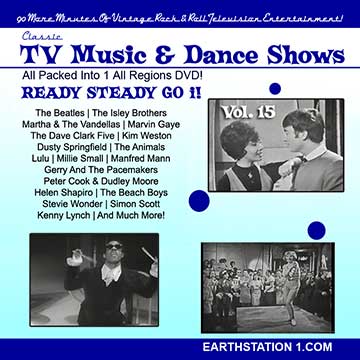
November 17, 1937: #BOTD: #HBD! Peter
Cook, dubbed "The Father Of Modern Satire", English
actor, satirist, writer, comedian and screenwriter, widely
regarded as the leading light of the British "satire boom"
of the 1960s (d. January 9, 1995) is #born Peter Edward Cook at
his parents' house, "Shearbridge", in Middle Warberry
Road, Torquay, Devon, and was educated at the University of
Cambridge. There he became involved with the Footlights Club, of
which he later became president. After graduating he created the
comedy stage revue Beyond The Fringe, beginning a long-running
partnership with Dudley Moore. In 1961, Cook opened the comedy
club The Establishment in Soho, Central London. In 1965, Cook and
Moore began a television career, beginning with Not Only... But
Also. Cook's deadpan monologues contrasted with Moore's
buffoonery. They received the 1966 British Academy Television
Award for Best Entertainment Performance. Following the success of
the show, the duo appeared together in the films The Wrong Box
(1966) and Bedazzled (1967). Cook and Moore returned to television
projects continuing to the late 1970s, including co-presenting
Saturday Night Live in the United States. From 1978 until his
death in 1995, Cook no longer collaborated with Moore, apart from
a few cameo appearances but continued to be a regular performer in
British television and film. Peter Cook died in a coma at age 57
at the Royal Free Hospital in Hampstead, London, from a
gastrointestinal haemorrhage, a complication probably resulting
from years of heavy drinking. His body was cremated at Golders
Green Crematorium, and his ashes were buried in an unmarked plot
behind St John-at-Hampstead, not far from his home in Perrins
Walk. Cook was ranked number one in the Comedians' Comedian, a
poll of over 300 comics, comedy writers, producers, and directors
throughout the English-speaking world. He was closely associated
with the anti-establishment comedy that emerged in the United
Kingdom and United States in the late 1950s. On Sale @ 15% Off
Discount Till Midnight PT!
https://store.earthstation1.com/classic-tv-music-amp-dance-shows-15-ready-steady-go-ii-d15.html
Today's
EarthStation1.com 15% Off Commemorative Memorial Title: DJ
Madness! 1950s-60s-70s Radio Shows DVD, MP3 Download, USB Drive
Today, November 17, 2025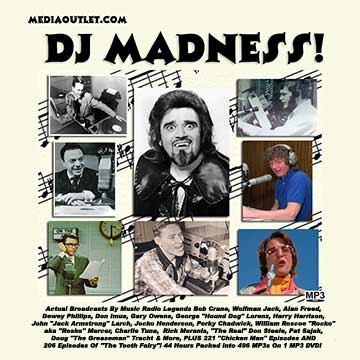
November 17, 1938: #BOTD: #HBD! Gordon
Lightfoot, Canadian singer-songwriter and guitarist (d. May 1,
2023) is #born Gordon Meredith Lightfoot Jr. in Orillia, Ontario
to Gordon Lightfoot, Sr., who managed a local dry cleaning firm,
and Jessie Vick Trill Lightfoot. Gordon Meredith Lightfoot Jr. CC
OOnt achieved international success in folk, folk-rock, and
country music. He is credited with helping to define the folk-pop
sound of the 1960s and 1970s. He is often referred to as Canada's
greatest songwriter and is known internationally as a folk-rock
legend. Lightfoot's songs, including "For Lovin' Me",
"Early Morning Rain", "Steel Rail Blues",
"Ribbon of Darkness"-a number one hit on the U.S.
country chart with Marty Robbins's cover in 1965-and "Black
Day in July" about the 1967 Detroit riot, brought him wide
recognition in the 1960s. Canadian chart success with his own
recordings began in 1962 with the No. 3 hit "(Remember Me)
I'm the One", followed by recognition and charting abroad in
the 1970s. He topped the US Hot 100 or AC chart with the hits "If
You Could Read My Mind" (1970), "Sundown" (1974);
"Carefree Highway" (1974), "Rainy Day People"
(1975), and "The Wreck of the Edmund Fitzgerald" (1976),
and had many other hits that appeared in the top 40. Several of
Lightfoot's albums achieved gold and multi-platinum status
internationally. His songs have been recorded by renowned artists
such as Elvis Presley, Johnny Cash, Hank Williams Jr., The
Kingston Trio, Marty Robbins, George Hamilton IV, Jerry Lee Lewis,
Neil Young, Bob Dylan, Judy Collins, Barbra Streisand, Johnny
Mathis, Herb Alpert, Harry Belafonte, Scott Walker, Sarah
McLachlan, Eric Clapton, John Mellencamp, Jack Jones, Bobby Vee,
Roger Whittaker, Tony Rice, Peter, Paul and Mary, Glen Campbell,
The Grateful Dead, The Irish Rovers, Nico, Olivia Newton-John,
Paul Weller, Nine Pound Hammer, Ultra Nate, The Tragically Hip,
The Unintended and Headstones. Robbie Robertson of the Band
described Lightfoot as "a national treasure". Bob Dylan,
also a Lightfoot fan, called him one of his favorite songwriters
and, in an often-quoted tribute, Dylan observed that when he heard
a Lightfoot song he wished "it would last forever".
Lightfoot was a featured musical performer at the opening
ceremonies of the 1988 Winter Olympic Games in Calgary, Alberta.
He received an honorary Doctor of Laws degree from Trent
University in Spring 1979 and was made a Companion of the Order of
Canada in May 2003. In November 1997, the Governor General's
Performing Arts Award, Canada's highest honour in the performing
arts, was bestowed on Lightfoot. On February 6, 2012, Lightfoot
was presented with the Queen Elizabeth II Diamond Jubilee Medal by
the Lieutenant Governor of Ontario. June of that year saw his
induction into the Songwriters Hall of Fame. On June 6, 2015,
Lightfoot received an honorary doctorate of music in his hometown
of Orillia from Lakehead University. Gordon Lightfoot died of
natural causes at Sunnybrook Health Sciences Centre in Toronto,
Canada at the age of 84. The Mariners' Church in Detroit (the
"Maritime Sailors' Cathedral" mentioned in "The
Wreck of the Edmund Fitzgerald") honored Lightfoot the day
after his death by ringing its bell a total of 30 times, 29 for
each of the crewmen lost on the Edmund Fitzgerald, and the final
time for Lightfoot himself. Additionally, the Split Rock
Lighthouse, which overlooks Lake Superior in Minnesota, shone its
light in honor of Lightfoot on May 3. A public visitation was held
at St. Paul's United Church that drew more than 2,400 people. As
in Detroit, the church bells at St. Paul's rang 30 times. On May
8, 2023, a private funeral was held at St. Paul's before he was
buried next to his parents at St. Andrew's and St. James'
Cemetery. On Sale @ 15% Off Discount Till Midnight PT!
https://store.earthstation1.com/dj-radio-airchecks-mp3-dvd-1950s60s70s-dis319506070.html
Today's
EarthStation1.com 15% Off Commemorative Memorial Title: TV Music &
Dance Shows #8 American Action DVD, MP4, USB Flash Drive
Today, November 17, 2025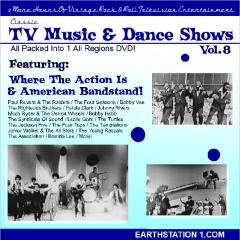
November 17, 1942: #BOTD: #HBD! Bob
Gaudio, American singer, songwriter, pianist and record producer,
and the keyboardist backing vocalist and usual songwriter of the
Four Seasons is #born Robert John Gaudio in the Bronx, New York.
Gaudio wrote or co-wrote and produced the vast majority of the
band's music, including hits like "Sherry" and
"December, 1963 (Oh, What a Night)". Though he no longer
performs with the group, Gaudio and lead singer Frankie Valli
remain co-owners of the Four Seasons brand. He was raised in
Bergenfield, New Jersey, where he attended Bergenfield High
School. His mother worked for the publishing house Prentice Hall
and his father in a paper factory. He showed an interest in music
and studied piano with Sal Mosca. Gaudio grew up in more
comfortable middle class surroundings than the other members of
the Four Seasons, which caused some tension and differences early
on. He was a cerebral person, interested in reading and learning.
He stayed out of trouble and kept a mild manner about him, which
proved useful during negotiations throughout his career. He rose
to musical fame at the age of 15 as a member of The Royal Teens
when he co-wrote the hit "Short Shorts". In 1958, while
he and the group were promoting the single, they met Frankie Valli
and his group the Four Lovers as they prepared to perform on a
local television program. Wearying of touring, he left the Royal
Teens soon afterward, and the rest of the group dissolved shortly
afterwards. One year after he ceased touring, Gaudio joined the
Four Lovers. While commercial success was elusive, the group was
kept busy with steady session work (with Bob Crewe as the
producer) and a string of performances at night clubs and lounges.
In 1960, after a failed audition at a bowling establishment in
Union Township, called the "4 Seasons",
songwriter/pianist Gaudio shook hands with lead singer Valli and
formed the Four Seasons Partnership, and Gaudio, Valli, Tommy
DeVito, and Nick Massi became The Four Seasons. Gaudio wrote the
Seasons' first No. 1 hit, "Sherry", 15 minutes before a
group rehearsal in 1962. With producer Bob Crewe often assisting
with lyrics, Gaudio wrote a string of subsequent hits for the
Seasons, including "Big Girls Don't Cry", "Walk
Like a Man", "Dawn (Go Away)", "Ronnie",
"Rag Doll", "Save It for Me", "Big Man in
Town", "Bye Bye Baby", "Girl Come Running",
"Beggin'", and "Can't Take My Eyes Off You"
(the first big success under Valli's name as a solo performer).
Crewe/Gaudio compositions also became major hits for other
artists, including the Tremeloes ("Silence Is Golden",
originally the B-side of the Four Seasons' "Rag Doll"),
The Osmonds ("The Proud One", originally recorded as a
Valli solo single) and the Walker Brothers ("The Sun Ain't
Gonna Shine Anymore", another Valli single). "Rag Doll"
is regarded by some as the greatest achievement of the Four
Seasons. Gaudio was on the way to a recording session and his car
was stopped at a long traffic light in Hell's Kitchen. Often kids
would wash the car windows during the long waits and ask for some
change. In Gaudio's case, a scruffy little girl washed his window.
When Gaudio went to give her change, all he had was a 20M USD
bill. After a moment's hesitation, he gave her the bill because he
had to give her something. The astonished look on her face stayed
with him and inspired the subsequent song. After the Beatles' Sgt.
Pepper's Lonely Hearts Club Band album was released in June 1967,
Gaudio saw the pop music market changing, and sought to position
the Four Seasons into the trend of socially conscious music. One
evening he went to the Bitter End in Greenwich Village and saw
Jake Holmes performing. Gaudio was taken with Holmes' song,
"Genuine Imitation Life", and decided to base a Four
Seasons album upon it. With Holmes as his new lyricist, The
Genuine Imitation Life Gazette album was released in January 1969.
The album was a commercial failure and symbolized the end of the
Four Seasons' first period of success. The appreciation of The
Genuine Imitation Life Gazette has grown over the years, and it
was re-released on CD (minus the newspaper cover) in the 1990s by
Rhino in the U.S. and Ace in the UK. Gaudio and Holmes also wrote
and produced Frank Sinatra's 1969 album Watertown. In 1975 Gaudio
wrote "Who Loves You" and "December 1963 (Oh, What
a Night)" with his future wife Judy Parker. The songs became
big hits for a reconstituted Four Seasons group (only Valli was
left of the original lineup; Gaudio stopped touring with them in
1971 to concentrate on writing and producing). Gaudio, Tommy
DeVito, Frankie Valli and Nick Massi - the original members of The
Four Seasons - were inducted into The Rock And Roll Hall Of Fame
in 1990 and the Vocal Group Hall of Fame in 1999. In addition to
his work for the Seasons and Sinatra, he wrote and/or produced for
Michael Jackson, Barry Manilow, Diana Ross, Eric Carmen, Nancy
Sinatra, Peabo Bryson, and Roberta Flack. In particular, he
produced six complete albums for Neil Diamond, and the movie
soundtrack albums for Diamond's The Jazz Singer and Little Shop of
Horrors. Gaudio also produced the hit "You Don't Bring Me
Flowers" for Barbra Streisand and Neil Diamond, a duet that
reached the top of Billboard charts in 1978, for which he received
a Grammy Award nomination. In the 1990s Gaudio moved to Nashville
and produced recordings for Canadian country artist George Fox,
among others. He lured Neil Diamond to Nashville to record the
album Tennessee Moon. In recent years Gaudio has focused on
musical theater, writing the music for the 2001 London West End
production of Peggy Sue Got Married. Gaudio was instrumental in
mounting Jersey Boys, a musical play based on the lives of the
Four Seasons, which ran at the La Jolla Playhouse through January
2, 2005, and then opened on Broadway on November 6, 2005, to
mostly positive reviews. In 2006, the play won four Tony Awards,
including Best Musical. In 2007, it won a Grammy in the Best
Musical Show Album category. Gaudio was inducted into the
Songwriters Hall of Fame in 1995. On February 3, 2009, Gaudio
received his high school diploma, 50 years after dropping out of
Bergenfield High School. On May 12, 2012, Gaudio received the
Ellis Island Medal Of Honor for his commitment to many
humanitarian causes. On June 20, 2014, Warner Bros. released the
film version of Jersey Boys, directed by Clint Eastwood in which
Gaudio was portrayed by Erich Bergen. In Jersey Boys, credit is
given to a then-teenaged Joe Pesci for introducing Gaudio to Tommy
DeVito. On July 1, 2014, Rhino Entertainment released Audio with a
G, the first compilation of the music composed by Bob Gaudio as
performed by the Four Seasons, Frank Sinatra, Diana Ross, The
Temptations, Cher, Roberta Flack, Nina Simone, Jerry Butler, Chuck
Jackson and others. On Sale @ 15% Off Discount Till Midnight PT!
https://store.earthstation1.com/classic-tv-music-amp-dance-shows-8-where-american-action-is-dv8.html
Today's
EarthStation1.com 15% Off Commemorative Memorial Title: TV
Commercials: The Classics Vol. 4 DVD, Video Download, USB Drive
Today, November 17, 2025
November 17, 1944: #BOTD: #HBD! Tom
Seaver, nicknamed "Tom Terrific" (after the 1957-1959
animated series presented as part of the Captain Kangaroo
children's television show) and "The Franchise",
American professional baseball pitcher who played 20 seasons in
Major League Baseball (MLB), 12-time All-Star and ranks as the
Mets' all-time leader in wins pitched, commonly described as the
most iconic player in Mets history, having played a significant
role in their victory in the 1969 World Series over the Baltimore
Orioles (d. August 31, 2020) is #born George Thomas Seaverin
Fresno, California. He played for the New York Mets, Cincinnati
Reds, Chicago White Sox, and Boston Red Sox from 1967 to 1986.
With the Mets, Seaver won the National League's (NL) Rookie of the
Year Award in 1967, and won three NL Cy Young Awards as the
league's best pitcher. During his MLB career, he compiled 311
wins, 3,640 strikeouts, 61 shutouts, a 2.86 earned run average,
and he threw a no-hitter in 1978. In 1992, Seaver was inducted
into the Baseball Hall of Fame in his first year of eligibility,
receiving the highest percentage of votes ever recorded at the
time. Along with Mike Piazza, he is one of two players wearing a
New York Mets hat on his plaque in the Hall of Fame. Seaver's No.
41 was retired by the Mets in 1988, and New York City changed the
address of Citi Field to 41 Seaver Way in 2019. Seaver is also a
member of the New York Mets Hall of Fame and the Cincinnati Reds
Hall of Fame. Seaver died in his sleep during the early hours of a
Monday at his home in Calistoga, California from complications
from Lewy body dementia and COVID-19 during the COVID-19 pandemic,
aged 75. His cremains were given to his widow Nancy. On Sale @ 15%
Off Discount Till Midnight PT!
https://store.earthstation1.com/tv-commercials-the-classics-vol-4-dv4.html
Today's
EarthStation1.com 15% Off Commemorative Memorial Title: Tibet
History & The Dalai Lama Documentaries DVD, MP4, USB Drive
Today, November 17, 2025
November 17, 1950: Religion: The History
Of Religion: Buddhism (Buddhadharma, Dharmavinaya): Mahayana
Buddhism: Tibetan Buddhism: Tibetan Buddhist Schools: Gelug School
Of Tibetan Buddhism (Yellow Hat School Of Tibetan Buddhism): The
Dalai Lama (Tibetan: Dalai, "Ocean"; Lama, "Wisdom";
Dalai Lama, "Ocean Of Wisdom"): Dalai Lamas: Priestly
Accessions: Successions To The Position Of Dalai Lama: His
Holiness The 14th Dalai Lama (Birth Name Lhamo Dondrub): -- Lhamo
Dondrub is officially named the 14th Dalai Lama at the age of
fifteen, and thereby invested with temporal duties as head of The
Ganden Phodran (the Tibetan government) who had so installed him,
in the aftermath of The Battle Of Chamdo, in which Peoples
Republic Of China (PRC) forces annexed Central Tibet; he continued
to hold temporaral power over The Ganden Phodran and Tibet until
his exile in 1959. The 14th Dalai Lama (b. July 6, 1935; full
spiritual name: Jetsun Jamphel Ngawang Lobsang Yeshe Tenzin
Gyatso, shortened as Tenzin Gyatso; born Lhamo Thondup) is as of
2025 the incumbent Dalai Lama, the highest spiritual leader and
head of Tibetan Buddhism. He served as the resident spiritual and
temporal leader of Tibet before 1959 and subsequently led the
Tibetan government in exile represented by the Central Tibetan
Administration in Dharamsala, India. A belief central to the
Tibetan Buddhist tradition as well as the institution of the Dalai
Lama is that the reincarnated person is a living Bodhisattva,
specifically an emanation of Avalokitesvara (in Sanskrit) or
Chenrezig (in Tibetan), the Bodhisattva of Compassion. The
Mongolic words "Dalai Lama" mean "Ocean Of Wisdom".
The 14th Dalai Lama is also known to Tibetans as Gyalwa Rinpoche
("The Precious Jewel-like Buddha-Master"), Kundun ("The
Presence"), and Yizhin Norbu ("The Wish-Fulfilling
Gem"). His devotees, as well as much of the Western world,
often call him His Holiness the Dalai Lama. He is the leader and a
monk of the newest Gelug school of Tibetan Buddhism. The 14th
Dalai Lama was born to a farming family in Taktser (Hongya
village), in the traditional Tibetan region of Amdo, at the time a
Chinese frontier district. He was selected as the tulku of the
13th Dalai Lama in 1937, and formally recognised as the 14th Dalai
Lama in 1939. As with the recognition process for his predecessor,
a Golden Urn selection process was waived and approved by the
Nationalist government of China. His enthronement ceremony was
held in Lhasa on February 22, 1940. During the 1959 Tibetan
uprising, the Dalai Lama escaped to India, where he continues to
live. On April 29, 1959, the Dalai Lama established the
independent Tibetan government in exile in the north Indian hill
station of Mussoorie, which then moved in May 1960 to Dharamshala,
where he resides. He retired as political head in 2011 to make way
for a democratic government, the Central Tibetan Administration.
The Dalai Lama advocates for the welfare of Tibetans and since the
early 1970s has called for the Middle Way Approach with China to
peacefully resolve the issue of Tibet. This policy, adopted
democratically by the Central Tibetan Administration and the
Tibetan people through long discussions, seeks to find a middle
ground, "a practical approach and mutually beneficial to both
Tibetans and Chinese, in which Tibetans can preserve their culture
and religion and uphold their identity," and China's
assertion of sovereignty over Tibet, aiming to address the
interests of both parties through dialogue and communication and
for Tibet to remain a part of China. He criticised the CIA Tibetan
program, saying that its sudden end in 1972 proved it was
primarily aimed at serving American interests. Until reaching his
mid-80s, the Dalai Lama travelled worldwide to give Tibetan
Mahayana and Vajrayana Buddhism teachings, and his Kalachakra
teachings and initiations were international events. He also
attended conferences on a wide range of subjects, including the
relationship between religion and science, met with other world
leaders, religious leaders, philosophers, and scientists, online
and in-person. Since 2018, he has continued to teach on a reduced
schedule, limiting his travel to within India only, and
occasionally addressing international audiences via live webcasts.
His work includes focus on the environment, economics, women's
rights, nonviolence, interfaith dialogue, physics, astronomy,
Buddhism and science, cognitive neuroscience, reproductive health
and sexuality. The Dalai Lama was awarded the Nobel Peace Prize in
1989. Time magazine named the Dalai Lama Gandhi's spiritual heir
to nonviolence. The 12th General Assembly of the Asian Buddhist
Conference for Peace in New Delhi unanimously recognised the Dalai
Lama's contributions to global peace, his lifelong efforts in
uniting Buddhist communities worldwide, and bestowed upon him the
title of "Universal Supreme Leader of the Buddhist World";
they also designated 6 July, his birthday, as the Universal Day of
Compassion. On Sale @ 15% Off Discount Till Midnight PT!
https://store.earthstation1.com/tibet-documentaries-2-dvd-se2.html
Today's
EarthStation1.com 15% Off Commemorative Memorial Title: War And
Peace In The Nuclear Age TV Series DVD, Download, USB Drive
Today, November 17, 2025
November 17, 1969 - The Aftermath Of
World War II: The Cold War: Arms Control: Nuclear Arms Control:
The Strategic Arms Limitation Talks (SALT): SALT I: -- The first
of The Strategic Arms Limitation Talks (SALT) begin, talks that
would ultimately lead to The SALT I agreement to sign The
Anti-Ballistic Missile Treaty (ABM Treaty or ABMT) in 1972. The
Strategic Arms Limitation Talks (SALT) were two rounds of
bilateral conferences and corresponding international treaties
involving the United States and the Soviet Union, the Cold War
superpowers, on the issue of arms control. The two rounds of talks
and agreements were SALT I and SALT II. Negotiations commenced in
Helsinki, Finland, in November 1969. SALT I led to the
Anti-Ballistic Missile Treaty and an interim agreement between the
two countries. Although SALT II resulted in an agreement in 1979,
the United States Senate chose not to ratify the treaty in
response to the Soviet war in Afghanistan, which took place later
that year. The Soviet legislature also did not ratify it. The
agreement expired on December 31, 1985 and was not renewed. The
talks led to the STARTs, or Strategic Arms Reduction Treaties,
which consisted of START I (a 1991 completed agreement between the
United States and the Soviet Union) and START II (a 1993 agreement
between the United States and Russia, which was never ratified by
the United States), both of which proposed limits on
multiple-warhead capacities and other restrictions on each side's
number of nuclear weapons. A successor to START I, New START, was
proposed and was eventually ratified in February 2011. On Sale @
15% Off Discount Till Midnight PT!
https://store.earthstation1.com/war-and-peace-in-the-nuclear-age-dvd-set-tv-series-7-disc7.html
Today's
EarthStation1.com 15% Off Commemorative Memorial Title: War Crimes
The Nuremberg My Lai John Demjanjuk Trials MP4 Download DVD
Today, November 17, 2025
November 17, 1970: The Aftermath Of World
War II: The Cold War: The Cold War In Asia: The Indochina Wars:
The Vietnam War (The Second Indochina War, The Vietnam Conflict,
The Resistance War Against America): The United States In The
Vietnam War: War Crimes: War Crimes Of The Vietnam War: The My Lai
Massacre (The Pinkville Massacre, The Massacre At Songmy, Son My
Massacre): -- Lieutenant William Calley goes on trial for the My
Lai Massacre, the Vietnam War mass killing of between 347 and 504
unarmed Vietnamese civilians in South Vietnam on March 16, 1968.
It was committed by U.S. Army soldiers from Company C, 1st
Battalion, 20th Infantry Regiment, 11th Brigade, 23rd (Americal)
Infantry Division. Victims included men, women, children, and
infants. Some of the women were gang-raped and their bodies
mutilated. Twenty-six soldiers were charged with criminal
offenses, but only Lieutenant William Calley Jr., a platoon leader
in C Company, was convicted. Found guilty of killing 22 villagers,
he was originally given a life sentence, but served only three and
a half years under house arrest. The massacre, which was later
called "the most shocking episode of the Vietnam War",
took place in two hamlets of Son My village in Quang Ngai
Province. These hamlets were marked on the U.S. Army topographic
maps as My Lai and My Khe. The U.S. Army slang name for the
hamlets and sub-hamlets in that area was Pinkville, and the
carnage was initially referred to as the Pinkville Massacre.
Later, when the U.S. Army started its investigation, the media
changed it to the Massacre at Songmy. Currently, the event is
referred to as the My Lai Massacre in the United States and called
the Son My Massacre in Vietnam. The incident prompted global
outrage when it became public knowledge as a result of Hersh's
story. The My Lai massacre increased domestic opposition to the
U.S. involvement in the Vietnam War when the scope of killing and
cover-up attempts were exposed. Initially, three U.S. servicemen
who had tried to halt the massacre and rescue the hiding civilians
were shunned, and even denounced as traitors by several U.S.
Congressmen, including Mendel Rivers, Chairman of the House Armed
Services Committee. Only after thirty years were they recognized
and decorated, one posthumously, by the U.S. Army for shielding
non-combatants from harm in a war zone. Along with the No Gun Ri
massacre in Korea eighteen years earlier, My Lai was one of the
largest single massacres of civilians by U.S. forces in the 20th
century. On Sale @ 15% Off Discount Till Midnight PT!
https://store.earthstation1.com/war-crimes-the-nuremberg-my-lai-john-demjanjuk-trials-mp4-download-dv4.html
Today's
EarthStation1.com 15% Off Commemorative Memorial Title:
Unauthorized Biography: Richard Nixon w/Barbara Howar MP4 Download
DVD
Today, November 17, 2025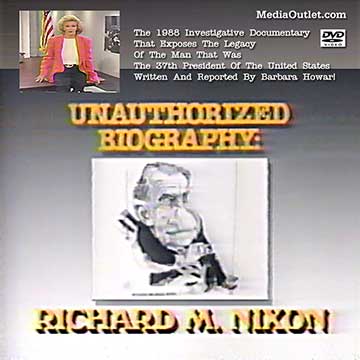
November 17, 1973: Scandals: Political
Scandals: Political Scandals Of The United States: Richard Nixon:
The Presidency Of Richard Nixon: The Watergate Scandal: "I'm
Not A Crook": -- In Orlando, Florida, U.S. President Richard
Nixon, responding to more than an hour of questioning by 400
Associated Press managing newspaper editors, declares on a
Saturday night that "I'm not a crook", and he would
prove it by publishing evidence of his innocence in the
wide-ranging Watergate scandal. In a nervous but self-assured
defense of his conduct before national television cameras in a
hotel ballroom at Disney World, Nixon said "I want the facts
out because the facts will prove that the President is telling the
truth." Nixon flew to the 27,000-acre entertainment resort
from his home in Key Biscayne and submitted to an hour and six
minutes of questions by members of the Associated Press Managing
Editors Association, the subjects ranging from the Watergate tapes
to his personal finances, the energy crisis, the new special
Watergate prosecutor and the acknowledged bugging of his brother,
Donald. During the news conference, Nixon said he would make
available his own notes to U.S. District Judge John J. Sirica of
his conversations with former White House counsel John W, Dean Ill
to establish that he knew nothing of the Watergate cover-up before
last March 21. He said it was a "very great disappointment"
some conversations were not recorded because of what he said was a
faulty, unsophisticated White House taping system. He further
stated that the new special Watergate prosecutor, Leon Jaworski,
would be fully independent and immune to dismissal without the
agreement of the House and Senate leadership of both parties. On
Sale @ 15% Off Discount Till Midnight PT!
https://store.earthstation1.com/unauthorized-biography-richard-nixon-dvd-documentary.html
Today's
EarthStation1.com 15% Off Commemorative Memorial Title:
Czechoslovakia: The Long Wait For Revolution DVD, Download, USB
Drive
Today, November 17, 2025
November 17, 1989: The Aftermath Of World
War II: The Cold War: The Cold War (1985-1991) (The End Of The
Cold War): The Dissolution Of The Soviet Union: The Revolutions Of
1989 (The Fall Of Nations, The Autumn Of Nations, The Fall Of
Communism): The Eastern Bloc (The Communist Bloc, The Socialist
Bloc, The Soviet Bloc): The Velvet Revolution (Czech: Sametova
Revoluce) (The Gentle Revolution): -- The Velvet Revolution begins
when thousands of student demonstrators marched through the
streets of Prague demanding an end to Communist rule in
Czechoslovakia. Riot police and army paratroopers then moved in to
crush the revolt. This sparks an uprising aimed at overthrowing
the communist government that ultimately succeeds on December 29.
The Velvet Revolution (Czech: sametova revoluce) or Gentle
Revolution (Slovak: nezna revolucia) was a non-violent transition
of power in what was then Czechoslovakia, occurring from November
17 to December 29, 1989. Popular demonstrations against the
one-party government of the Communist Party of Czechoslovakia
included students and older dissidents. The result was the end of
41 years of one-party rule in Czechoslovakia, and the subsequent
dismantling of the command economy and conversion to a
parliamentary republic. On November 17, 1989, the semicentennial
anniversary of International Students' Day, riot police suppressed
a student demonstration in Prague. The event marked the 50th
anniversary of a violently suppressed demonstration against the
Nazi storming of Prague University in 1939 where 1,200 students
were arrested and 9 killed. The 1989 event sparked a series of
demonstrations from November 17 to late December and turned into
an anti-communist demonstration. On November 20, the number of
protesters assembled in Prague grew from 200,000 the previous day
to an estimated 500,000. The entire top leadership of the
Communist Party, including General Secretary Milos Jakes, resigned
on November 24. On November 27, a two-hour general strike
involving all citizens of Czechoslovakia was held. In response to
the collapse of other Warsaw Pact governments and the increasing
street protests, the Communist Party of Czechoslovakia announced
on November 28 that it would relinquish power and end the
one-party state. Two days later, the federal parliament formally
deleted the sections of the Constitution giving the Communist
Party a monopoly of power. Barbed wire and other obstructions were
removed from the border with West Germany and Austria in early
December. On December 10, President Gustav Husak appointed the
first largely non-communist government in Czechoslovakia since
1948, and resigned. Alexander Dubcek was elected speaker of the
federal parliament on December 28, and Vaclav Havel the President
of Czechoslovakia on December 29, 1989. In June 1990,
Czechoslovakia held its first democratic elections since 1946. On
January 1. 1993, Czechoslovakia split into two countries: the
Czech Republic and Slovakia. On Sale @ 15% Off Discount Till
Midnight PT!
https://store.earthstation1.com/czechoslovakia-the-long-wait-for-spring-dvd-1988-cold1988.html
Today's
EarthStation1.com 15% Off Commemorative Memorial Title: War Crimes
In Bosnia: The Bosnian War MP4 Video Download Or DVD
Today, November 17, 2025
November 17, 1993: The Post-Cold War Era:
The Breakup Of Yugoslavia: The Yugoslav Wars: The United Nations:
International Humanitarian Law (IHL) (The Laws Of Armed Conflict):
The International Criminal Tribunal For The Former Yugoslavia
(ICTY): -- The United Nations opens the International Criminal
Tribunal For The Former Yugoslavia, its first war crimes tribunal
since the Nuremberg and Tokyo trials following World War II.
Judges from 11 nations were sworn in on this date to examine the
recent mass murders in Yugoslavia characterized as ethnic
cleansing committed by Serbs, Croats and Albanians during the
Yugoslav Wars. The International Tribunal for the Prosecution of
Persons Responsible for Serious Violations of International
Humanitarian Law Committed in the Territory of the Former
Yugoslavia since 1991, more commonly referred to as the
International Criminal Tribunal for the former Yugoslavia (ICTY),
was a body of the United Nations established to prosecute serious
crimes committed during the Yugoslav Wars, and to try their
perpetrators. The tribunal was an ad hoc court located in The
Hague, Netherlands. The Court was established by Resolution 827 of
the United Nations Security Council, which was passed on May 25,
1993. It had jurisdiction over four clusters of crimes committed
on the territory of the former Yugoslavia since 1991: grave
breaches of the Geneva Conventions, violations of the laws or
customs of war, genocide, and crimes against humanity. The maximum
sentence it could impose was life imprisonment. Various countries
signed agreements with the UN to carry out custodial sentences. A
total of 161 persons were indicted; the final indictments were
issued in December 2004, the last of which were confirmed and
unsealed in the spring of 2005. The final fugitive, Goran Hadzic,
was arrested on July 20, 2011. The final judgment was issued on
November 29, 2017 and the institution formally ceased to exist on
December 31, 2017. Residual functions of the ICTY, including
oversight of sentences and consideration of any appeal proceedings
initiated since July 1, 2013, are under the jurisdiction of a
successor body, the International Residual Mechanism for Criminal
Tribunals (IRMCT). On Sale @ 15% Off Discount Till Midnight PT!
https://store.earthstation1.com/war-crimes-in-bosnia-the-bosnian-war-mp4-video-download-or-dvd.html
Today's
EarthStation1.com #OnThisDay Commemorative Memorial Title: Lum And
Abner Old Time Radio Series MP3 Set DVD, Download, USB Stick
Today, November 17, 2025 November 17: National Homemade Bread Day:
-- Time to get baking and break bread with your friends and
family! The best thing about tdoay might be the way it
incorporates all your senses: the sweet, roasty comfort smell that
lingers in the kitchen; the sight of steam rising from the top of
the loaf, the warmth in your mouth, the taste of home when you
take a bite, and the seemingly automatic "Mmmmm" that
comes while you chew. Sliced bread is undoubtedly a good thing -
it saves time, and the effort of kneading. But it's a real shame
that so few people today get to enjoy the taste and yeasty
deliciousness that is homemade bread -- and that's where Home-Made
Bread Day comes in! The origins of this particular Day are
shrouded in mystery, but the history of bread obviously follows
along with the history of humanity itself. Bread has been an
important part of diet and culture and has appeared in pretty much
every corner of the world in some form or another. It is estimated
that grains and cereals became an important part of the human diet
long before bread came along. Bread, itself, is believed to have
entered the scene perhaps as long as 10,000 years ago, during the
Neolithic period in Europe. Some loaves of bread even from that
long ago used the concept of retaining a piece of the previous
day's bread as a 'starter' in the fashion of sourdough bread. In
79 AD, the tragic volcano eruption of Pompeii preserved the city's
ovens so that archeologists would later find them. It was
discovered that the people from that time had access to bread that
was baked in at least 33 different bakeries. The invention of the
bread-maker has taken a lot of the effort out of baking, meaning
that there is no reason why everyone shouldn't enjoy homemade
bread, which is often of much higher quality than the stuff that
can be bought in a shop. Home-baked bread is often healthier,
higher in fiber, and lower in salt and additives than commercial
varieties, and the recipe can be modified to suit the maker's
tastes, with grains, spices, or other additions. No matter its
form, homemade bread is absolutely delicious and deserves to be
celebrated on this day!
https://store.earthstation1.com/lum-and-abner-radio-mp3-dvd-complete-broadcast3.html
November 17: National Homemade Bread Day:
-- Time to get baking and break bread with your friends and
family! The best thing about tdoay might be the way it
incorporates all your senses: the sweet, roasty comfort smell that
lingers in the kitchen; the sight of steam rising from the top of
the loaf, the warmth in your mouth, the taste of home when you
take a bite, and the seemingly automatic "Mmmmm" that
comes while you chew. Sliced bread is undoubtedly a good thing -
it saves time, and the effort of kneading. But it's a real shame
that so few people today get to enjoy the taste and yeasty
deliciousness that is homemade bread -- and that's where Home-Made
Bread Day comes in! The origins of this particular Day are
shrouded in mystery, but the history of bread obviously follows
along with the history of humanity itself. Bread has been an
important part of diet and culture and has appeared in pretty much
every corner of the world in some form or another. It is estimated
that grains and cereals became an important part of the human diet
long before bread came along. Bread, itself, is believed to have
entered the scene perhaps as long as 10,000 years ago, during the
Neolithic period in Europe. Some loaves of bread even from that
long ago used the concept of retaining a piece of the previous
day's bread as a 'starter' in the fashion of sourdough bread. In
79 AD, the tragic volcano eruption of Pompeii preserved the city's
ovens so that archeologists would later find them. It was
discovered that the people from that time had access to bread that
was baked in at least 33 different bakeries. The invention of the
bread-maker has taken a lot of the effort out of baking, meaning
that there is no reason why everyone shouldn't enjoy homemade
bread, which is often of much higher quality than the stuff that
can be bought in a shop. Home-baked bread is often healthier,
higher in fiber, and lower in salt and additives than commercial
varieties, and the recipe can be modified to suit the maker's
tastes, with grains, spices, or other additions. No matter its
form, homemade bread is absolutely delicious and deserves to be
celebrated on this day!
https://store.earthstation1.com/lum-and-abner-radio-mp3-dvd-complete-broadcast3.html
Today's
EarthStation1.com #OnThisDay Commemorative Memorial Title: The Old
Time Radio Sci-Fi & Paranormal MP3 MegaSet CD, Download, USB
Today, November 17, 2025November 17: National Butter Day: -- Few
ingredients make a meal richer and more flavorful than butter -
and this annual celebration of this delicious dairy product gives
this creamy ingredient, and those who make it, a pat on the back!
Butter has been used by humans for thousands of years. As recently
as the first half of the last century, the butter churn was an
essential tool in many kitchens. When butter was rationed during
World War II, households struggled to get along without this
delicious staple. As Julia Child said, :With enough butter,
anything is good"! Butter can be used in simple and complex
ways - spread a pat of butter on warm toast for an instant hit of
flavor and texture or use it to create the light, flaky layers in
a croissant. It also enhances the mouthfeel of hot drinks, like
coffee and cocktails, and it keeps meats tender while roasting.
Butter is the crucial ingredient in mouthwatering sauces, rich
cookies, creamy mashed potatoes, hearty casseroles, and so much
more. The average American eats 6.3 pounds, or about 25 sticks, of
cow's butter every year. Around the world, butter can be found in
cuisines of every culture, and each one uses it to enhance their
recipes and enrich their lives. Around the dinner table, the
phrase "Please, pass the butter," connects us to those
we break bread with and to the food we love to eat. National
Butter Day invites you to celebrate your favorite dishes and baked
goods with butter. National Butter Day offers so many avenues for
celebration. Whether you set to work in your kitchen making family
favorites or test out a new recipe, take a moment to recognize the
role butter plays in our food: Bake cookies with the kids. Be sure
to let them mix the butter and sugar together; Make compound or
brown butter and reap the flavor benefits; Thank a dairy farmer,
milk hauler, or butter maker, like those at Dinner Bell Creamery,
for the butter they make possible; Compliment the chef who made
the delicious, buttery sauce for your seafood meal; and when you
celebrate, be sure to share your stories and photos on social
media using #NationalButterDay! Dinner Bell Creamery - a
cooperative owned by the dairy farm families of AMPI - founded
National Butter Day in 2021 to celebrate this culturally important
and incredibly delicious food. They also honor the modern-day
process of butter making, from raising dairy cows on family farms
to crafting butter for sale in stores and markets.
https://store.earthstation1.com/the-old-time-radio-scifi-paranormal-megaset-dual-layer-mp3-dv3.html
Today's
EarthStation1.com #OnThisDay Commemorative Memorial Title: Scouts!
Lord Baden-Powell The Boy Scouts & The Girl Scouts MP4 DVD USB
Today, November 17, 2025November 17: National Hiking Day (Take A
Hike Day): -- Today may be one of the most important holidays out
there. Why? For starters, there's more than 60,000 miles of trails
across the nation. Not to mention, hiking is great exercise
allowing you to burn over 550 calories per hour. Plus, being in
the outdoors allows you to get away from your phone and appreciate
nature's beauty and wonder. Hiking wasn't always the fashionable
pastime it is today. Before the Subarus and the Jeeps and the
Patagonias built an industry around the activity, walking - of any
kind - was considered an activity for the impoverished or the
vagrant. Until the Romantic era of the Victorian years inspired
the likes of Walden and Thoreau to reconnect with nature and that,
in turn, inspired the landscape architects to design parks with
excellent walking trails (looking at you Frederick Law Olmsted of
Central Park fame). Walking then became something of the educated,
the unhurried, the luxurious. Until John Muir came along and
walked his way through the Sierra Nevadas in California and
demanded that not only hiking, walking, meandering, sojourning,
whatever you want to call it be accessible to every American
citizen, but that the country should actively preserve natural
areas of pristine ecology and beauty. So in 1890 he petitioned for
the creation of the National Park System and we were endowed with
"America's best idea" - Yosemite and Sequoia National
Park. But even before Muir, on the east coast a small group of
people had banded together in 1876 to form the Appalachian
Mountain Club, which had a goal to protect and preserve all hiking
trails along the historic mountain range, as well as develop new
ones. So whether you prefer to hit the jogging trails in Central
Park or are prepping to backpack the entire Pacific Crest Trail,
every step on a trail is with a long line of explorers,
trailblazers, and activists from before.
https://store.earthstation1.com/scouts-the-life-and-legacy-of-lord-badenpowell-dvd-mp4-us4.html
Today's
EarthStation1.com #OnThisDay Commemorative Memorial Title: The
Crimes Of Adolf Hitler Das Leben Von Adolf Hitler 1961 DVD MP4 USB
Today, November 17, 2025November 17, 1939: International
Students' Day: -- Nine Czech students are executed as a response
to anti-Nazi demonstrations at the University of Prague,
Czechoslovakia prompted by the death of medical student Jan
Opletal during the German Occupation Of Czechoslovakia. All Czech
universities are shut down and more than 1,200 students sent to
concentration camps. Since this event, International Students' Day
is celebrated in many countries, especially in the Czech Republic.
International Students' Day is an international observance of the
student community, held annually on November 17. Originally
commemorating the Czech universities which were stormed by Nazis
in 1939 and the students who were subsequently killed and sent to
concentration camps, it is now marked by a number of universities,
sometimes on a day other than November 17, as a nonpolitical
celebration of the multiculturalism of their international
students. The date commemorates the anniversary of the 1939 Nazi
storming of the University of Prague (Charles University) after
demonstrations against the German occupation of Czechoslovakia and
the killings of student protestors Jan Opletal and worker Vaclav
Sedlacek. The Nazis rounded up the students, murdered nine student
leaders and sent over 1,200 students to concentration camps,
mainly Sachsenhausen. They subsequently closed all Czech
universities and colleges. By this time Czechoslovakia no longer
existed, as it had been divided into the Protectorate of Bohemia
and Moravia and the Slovak Republic under a fascist puppet
government. In late 1939 the Nazi authorities in the Protectorate
of Bohemia and Moravia suppressed a demonstration in Prague held
by students of the Medical Faculty of Charles University. The
demonstration was held on October 28 to commemorate the
anniversary of the independence of the Czechoslovak Republic
(1918). During this demonstration the student Jan Opletal was
shot, and later died from his injuries on November 11. On November
15 his body was supposed to be transported from Prague to his home
in Moravia. His funeral procession consisted of thousands of
students, who turned the event into an anti-Nazi demonstration.
However, the Nazi authorities took drastic measures in response,
closing all Czech higher education institutions, arresting more
than 1,200 students, who were then sent to concentration camps,
executing nine students and professors without trial on November
17. Historians have concluded that the Nazis granted permission
for the funeral procession already expecting a violent outcome, in
order to use that as a pretext for closing down universities and
purging anti-fascist dissidents. The nine students and professors
executed on November 17 in Prague were: Josef Matousek (historian
and associate professor; participated in the organisation of
Opletal's funeral); Jaroslav Klima (student of law; Chairman of
the National Association of Czech Students in Bohemia and Moravia,
requested the release of students arrested by the Gestapo during
Opletal's funeral); Jan Weinert (student of Bohemistics and
Germanistics; requested the release of students arrested by the
Gestapo during Opletal's funeral); Josef Adamec (student of law;
secretary of the National Association of Czech Students in Bohemia
and Moravia); Jan Cerny (student of medicine; requested the
release of students arrested by the Gestapo during Opletal's
funeral); Marek Frauwirth (student of economics; as an employee of
the Slovak embassy in Prague, he was issuing false passports to
Jews trying to flee from the Nazis); Bedrich Koula (student of
law; secretary of the Association of Czech students in Bohemia);
Vaclav Safranek (student of architecture; record-keeper of the
National Association of Czech Students in Bohemia and Moravia);
and Frantisek Skorkovsky (student of law; Director of a Committee
of the Confederation Internationale des Etudiants, Chairman of the
Foreign Department of the National Association of Czech Students
in Bohemia and Moravia).
https://store.earthstation1.com/the-crimes-of-adolf-hitler-aka-das-leben-von-adolf-hitler-dvd.html
Today's
EarthStation1.com #OnThisDay Commemorative Memorial Title: The
Roaring Twenties: 1920s History Documentary DVD, MP4, USB Stick
Today, November 17, 2025November 17, 1955: #DOTD: #RIP: James P.
Johnson, African American pianist and composer (b. February 1,
1894) #dies in Jamaica, Queens, New York City of a stroke
sustained in 1951 that forced his retirement, aged 61. He is
buried at Mount Olivet Cemetery in Maspeth, Queens County, New
York. Unmarked since his death in 1955, his grave was
re-consecrated in 2009 with a headstone paid for with funds raised
by an event arranged by the James P. Johnson Foundation, Spike
Wilner and Dr. Scott Brown. James P. Johnson was born James Price
Johnson in New Brunswick, New Jersey. A pioneer of stride piano,
he was one of the most important pianists in the early era of
recording, and like Jelly Roll Morton, one of the key figures in
the evolution of ragtime into what was eventually called jazz.
Johnson was a major influence on Count Basie, Duke Ellington, Art
Tatum, and Fats Waller, who was his student. Johnson composed many
hit songs, including "Carolina Shout" and the unofficial
anthem of the Roaring Twenties, "The Charleston", and he
remained the acknowledged king of New York jazz pianists through
most of the 1930s. Johnson's artistry, influence on early popular
music, and contributions to musical theatre are often overlooked,
and as such, he has been referred to by musicologist David Schiff
as "The Invisible Pianist."
https://store.earthstation1.com/the-roaring-twenties-dvd-1920s-history-documentary-dvd-mp4-usb-19204.html
Today's
EarthStation1.com #OnThisDay Commemorative Memorial Title: Patti
Page Music TV Shows DVD, MP4 Video Download, USB Flash Drive
Today, November 17, 2025November 17, 2003: #DOTD: #RIP: Claude
Trenier, pioneer African American rock and roll singer and
cofounder of The Treniers (b. July 14, 1919) #dies on a Monday of
cancer at Nathan Adelson Hospice in Las Vega, Nevada, aged 84. He
is buried at Holy Cross Cemetery in Culver City, California. He
was born Claude Oliver Trenier along with his idential twin
brother Clifton L. "Cliff" Trenier in Mobile, Alabama.
The Treniers (pronounced TREY-niers) were an American R & B,
jump blues and rock and roll group led by Cliff and Claude
Trenier. They were originally billed as The Trenier Twins, who
performed alongside the Gene Gilbeaux Quartet, but shortened their
name to The Treniers when Gilbeaux and other musicians became
integral members of the group. Besides the Trenier brothers, group
members included Don Hill on saxophone, Shifty Henry and later
James (Jimmy) Johnson on bass, Henry (Tucker) Green on drums and
Gene Gilbeaux on piano. Later, additional Trenier brothers Milt
and Buddy, and nephew Skip, joined the group on vocals, and there
were many other musician and line-up changes over the years
including Herman Washington and Mickey Baker on guitar. The band
was based around twins Clifton L. "Cliff" Trenier (July
14, 1919 - March 2, 1983) and Claude Oliver Trenier (July 14, 1919
- November 17, 2003). They were born in Mobile, Alabama, and
formed the Alabama State Collegians when in college together in
1939. In 1943, Claude Trenier left to join Jimmie Lunceford's band
as lead singer, and Cliff joined him the following year. The twins
left the Lunceford band in 1947 and began performing together as
the Trenier Twins, backed by the Gene Gilbeaux Quartet which
included Gene Gilbeaux on piano and Don Hill on alto sax. They
made their first recordings for Mercury Records in 1947, and
developed a strong reputation for their live performances. In
1949, they were joined by older brother Buddy Trenier (December
11, 1913 - March 15, 1999), and started to be billed as "The
Rockin' Rollin' Treniers". They played a form of music
intermediate between swing and early rock and roll. Though their
sound is more swing influenced, the Treniers incorporated a
thumping backbeat and several songs that included the words "rock"
and "roll" - "Rocking on Sunday Night" and "It
Rocks! It Rolls! It Swings!", for example, and in the 1940s
were already playing "Rockin' Is Our Bizness," which was
inspired by Jimmie Lunceford's "Rhythm Is Our Business"
from the 1930s. They were also known for the humorous content of
many of their songs, and their on stage acrobatics were seen as
precursors to the wild antics of many later rock and roll groups.
Their lively stage presentation influenced Bill Haley and Comets,
The Shadows in the UK in 1959, Paul Revere and Raiders, and
beyond. They had their only national chart hit in 1951, when "Go!
Go! Go!" reached #10 on the R & B chart, but several of
their other records including "It Rocks! It Rolls! It
Swings!" (1952) and "Rockin' Is Our Bizness" (1953)
"anticipated some crucial elements of rock n roll with their
solid, thumping beats, their squealing sax solos." In the
1950s, they moved closer towards an R & B influenced sound,
but were unable to weather the influx of rock and roll.
Nonetheless the group was considered a strong influence on bands
such as their contemporaries Bill Haley and His Comets, and they
were one of the first to record Haley's "Rock-a-Beatin'
Boogie". Claude Trenier would later claim in an interview in
Blue Suede News magazine that his group was responsible for Haley
deciding to record rock and roll; this account is disputed. One of
the first times rock and roll appeared on national television was
in May 1954 when the Treniers appeared on the Colgate Comedy Hour,
hosted by Dean Martin and Jerry Lewis. During the playing of their
songs, Martin and Lewis participated in the antics, and when the
drummer got up and stepped aside, Jerry Lewis sat down and played
drums for one song. The group appeared in several films in the
1950s including The Girl Can't Help It and Don't Knock the Rock
(which also featured Haley), and continued to perform as recently
as 2003. In 1955, the group released the song "Say Hey (The
Willie Mays Song)" about Giants center fielder, Willie Mays,
which included some dialogue by the Hall-of-Famer himself. The
song is included on the soundtrack to Ken Burns 1994 documentary
Baseball. In 2013, surviving member Milt Trenier performed
semi-weekly at Chicago area restaurants.
https://store.earthstation1.com/patti-page-music-television-shows-dvd.html
Today's
EarthStation1.com #OnThisDay Commemorative Memorial Title: WABC
Radio Airchecks MP3 Collection 1960s-1980s DVD, MP3 Download, USB
Today, November 17, 2025November 17, 2014: #DOTD: #RIP: Jimmy
Ruffin, African American soul singer (b. May 7, 1936) #dies in Las
Vegas, Nevada of an undisclosed illness, aged 78. He is is buried
at Palm Memorial Park Northwest Cemetery, Las Vegas, Clark County,
Nevada in the Garden of Eternal Life Section. Jimmy Ruffin was
born Jimmy Lee Ruffin in Collinsville, Mississippi. He was the
elder brother of David Ruffin of the Temptations. He had several
hit records between the 1960s and 1980s, the most successful being
the Top 10 hits "What Becomes Of The Brokenhearted" and
"Hold On (To My Love)".
https://store.earthstation1.com/wabc-musicradio-shows-mp3-dvd-60s80s-am-360807775.html
Today's
EarthStation1.com #OnThisDay Commemorative Memorial Title: Rock &
Roll An Unruly History 10 Part TV Series MP4 Video Download DVD
Today, November 17, 2025November 17, 2008: #DOTD: #RIP: George
Stephen Morrison, United States Navy rear admiral (upper half) and
naval aviator who held significant commands of United States naval
forces during the Vietnam War, father of estranged son Jim
Morrison, the lead singer of the rock band The Doors (b. January
7, 1919) #dies in Coronado, California at the age of 89. His
private memorial service was held on November 24 at Fort Rosecrans
National Cemetery in San Diego. His ashes were scattered at sea
near the same spot off Point Loma where his wife's ashes had been
scattered nearly three years earlier. George Stephen Morrison was
born in Rome, Georgia. The Morrison family descended from Scottish
settlers who emigrated to America in the late 18th century. He
entered the U.S. Naval Academy in 1938, graduated in 1941, and was
commissioned an ensign. Sent to Hawaii, he joined the crew of the
destroyer USS Pruitt. On December 7, 1941, Morrison witnessed the
Japanese attack on Pearl Harbor. Morrison began flight training in
1943 at Naval Air Station Pensacola, Florida, and graduated in
spring 1944, and went on to fly combat missions in the Grumman F6F
Hellcat. He flew missions in the Pacific Theater for the duration
of World War II. He served as an instructor on nuclear weapons
programs following the end of the war, while during the Korean
War, he served at the joint operations center in Seoul. This
resulted in the award of the Bronze Star Medal with "V"
for Valor device. In November 1963, Morrison took command of the
Essex-class aircraft carrier USS Bon Homme Richard, flagship of
the First Fleet's Fifth Carrier Division in the Pacific, based at
San Diego, California. The Fifth Carrier Division was transferred
to the Seventh Fleet when sent to the Western Pacific early in
1964. Morrison's command of the Fifth Carrier Division did not, as
has sometimes been supposed, give him a significant role in the
controversial Gulf of Tonkin Incident in August 1964, which
increased the level of US involvement in the Vietnam War. The Bon
Homme Richard was cruising along the coast of Japan, from Sasebo
to Yokosuka, while the incidents were occurring off the coast of
North Vietnam. In 1967, Morrison was promoted to rear admiral. In
WestPac in 1968, he commanded a Task Group that was part of Task
Force 77 commanded by Vice Admiral Ralph Cousins; the USS Hancock
served as his flagship. Besides operations against communist
forces in North Vietnam, the task force was diverted to Korea in
December 1968 to support South Korean forces battling North Korean
infiltrators during the Korean DMZ Conflict. He successfully led
the Task Force in the interdiction of communist North Korean
forces in spite of attempts by Soviet Navy destroyers to prevent
flight operations by attempting to cross the path of the Hancock.
In 1972, he was appointed Commander Naval Forces Marianas. As
such, he was in charge of relief efforts for Vietnamese refugees
sent to Guam after the fall of Saigon in the spring of 1975.
Morrison was the keynote speaker at the decommissioning ceremony
for the carrier Bon Homme Richard, his first ship as an admiral,
on July 2, 1971, in Washington D.C. His estranged son, rock
musician Jim Morrison, died in Paris at age 27 the following day.
Morrison retired from the Navy in August 1975 as a rear admiral
(upper half).
https://store.earthstation1.com/rock-amp-roll-an-unruly-history-10-part-tv-series-mp4-video-download-104.html
Today's
EarthStation1.com #OnThisDay Commemorative Memorial Title: Sir
Arthur Harris Of RAF Bomber Command During WWII DVD, Download, USB
Today, November 17, 2025November 15-16/November 16-17, 1940: The
European Civil War: World War II: The Second European War (The
European Theater Of World War II): Aviation: Military Aviation:
Air Warfare Of World War II: Strategic Bombing During World War
II: European Air Operations During The Battle Of Europe: The
Bombing Of Hamburg In World War II: The Hamburg Air Raids Of The
Nights Of November 15/16 And November 16/17 1940: -- In response
to the leveling of Coventry by the German Luftwaffe two days
before, during what became known as The Coventry Blitz, the Royal
Air Force's Bomber Command executes two major bombing raids
against Hamburg on the consecutive nights of November 15-16, 1940
and November 16-17, 1940. Over 200 British aircraft were involved.
On the first night damage was caused to the Blohm & Voss
shipyard, and over 60 fires were started. On the second night only
60 aircraft found their target and damage was far less. The damage
and loss of life inflicted were far less than that inflicted by
the Germans upon Conventry on November 14-15, 1940, when Coventry
was heavily bombed by 515 German Luftwaffe bombers from Luftflotte
3 and from the pathfinders of Kampfgruppe 100 during the overnight
of November 14-15. Coventry Cathedral is almost completely
destroyed. The Coventry Blitz (blitz: from the German word
Blitzkrieg meaning "lightning war") was a series of
bombing raids that took place on the English city of Coventry. The
city was bombed many times during the Second World War by the
German Air Force (Luftwaffe). The most devastating of these
attacks occurred on the evening of November 14, 1940 and continued
into the morning of November 15. In one night, more than 4,300
homes in Coventry were destroyed and around two-thirds of the
city's buildings were damaged. The raid was heavily concentrated
on the city centre, most of which was destroyed. Two hospitals,
two churches and a police station were also damaged. The local
police force lost no fewer than nine constables or messengers in
the blitz. Approximately one third of the city's factories were
completely destroyed or severely damaged, another third were badly
damaged, and the rest suffered slight damage. Among the destroyed
factories were the main Daimler factory, the Humber Hillman
factory, the Alfred Herbert Ltd machine tool works, nine aircraft
factories, and two naval ordnance stores. However, the effects on
war production were only temporary, as much essential war
production had already been moved to 'shadow factories' on the
city outskirts. Also, many of the damaged factories were quickly
repaired and had recovered to full production within a few months.
An estimated 568 people were killed in the raid (the exact figure
was never precisely confirmed), with another 863 badly injured and
393 sustaining lesser injuries. Given the intensity of the raid,
casualties were limited by the fact that a large number of
Coventrians "trekked" out of the city at night to sleep
in nearby towns or villages following the earlier air raids. Also,
people who took to air raid shelters suffered very little death or
injury. Out of 79 public air raid shelters holding 33,000 people,
very few had been destroyed. The attack, code-named Operation
Mondscheinsonate (German: Operation Moonlight Sonata), inflicted
considerable damage to monuments and residential areas. The
initial wave of 13 specially modified Heinkel He 111 aircraft of
Kampfgruppe 100, which were equipped with X-Gerat (German:
X-Device) navigational devices, accurately dropped navigational
marker flares at 19:20. The British and the Germans were fighting
the Battle of the Beams and on this night the British failed to
disrupt the X-Gerat signals. The Battle of the Beams was a period
early in the Second World War when bombers of the German Air Force
(Luftwaffe) used a number of increasingly accurate systems of
radio navigation for night bombing in the United Kingdom. British
scientific intelligence at the Air Ministry fought back with a
variety of their own increasingly effective means, involving
jamming and distortion of the radio waves. The period ended when
the Wehrmacht moved their forces to the East in May 1941, in
preparation for the attack on the Soviet Union. The first wave of
follow-up bombers dropped high explosive bombs, knocking out the
utilities (the water supply, electricity network, telephones and
gas mains) and cratering the roads, making it difficult for the
fire engines to reach fires started by the later waves of bombers.
These later waves dropped a combination of high explosive and
incendiary bombs. There were two types of incendiary bomb: Those
made of magnesium and those made of petroleum. The high explosive
bombs and the larger air-mines not only hindered the Coventry fire
brigade, they were also intended to damage roofs, making it easier
for the incendiary bombs to fall into buildings and ignite them.
Coventry's air defences consisted of twenty-four 3.7 inch AA guns
and twelve 40 mm Bofors. The AA Defence Commander of 95th
(Birmingham) Heavy Anti-Aircraft Regiment, Royal Artillery, had
prepared a series of concentrations to be fired using
sound-locators and GL Mk. I gun-laying radar, and 128
concentrations were fired before the bombing severed all lines of
communication and the noise drowned out sound-location. The
anti-aircraft batteries then fought on in isolation. Some gun
positions were able to fire at searchlight beam intersections,
glimpsed through the smoke and guessing the range. Although the
Coventry guns fired 10 rounds a minute for the whole 10 hour raid
(a total of over 6,700 rounds), only one German bomber was shot
down. At around 20:00, Coventry Cathedral (dedicated to Saint
Michael), was set on fire by incendiaries for the first time. The
volunteer firefighters managed to put out the first fire but other
direct hits followed and soon new fires broke out in the
cathedral; accelerated by a firestorm, the flames quickly spread
out of control. During the same period, more than 200 other fires
were started across the city, most of which were concentrated in
the city-centre area, setting the area ablaze and overwhelming the
firefighters. The telephone network was crippled, hampering the
fire service's command and control and making it difficult to send
firefighters to the most dangerous blazes first; as the Germans
had intended, the water mains were damaged by high explosives,
meaning there was not enough water available to tackle many of the
fires. The raid reached its climax around midnight with the final
all clear sounding at 06:15 on the morning of November 15.
Although the city centre suffered the heaviest raids, districts of
the city including Stoke Heath, Foleshill and Wyken were also
heavily bombed. The raid reached such a new and severe level of
destruction that Joseph Goebbels later used the term coventriert
("coventried") when describing similar levels of
destruction of other enemy towns. During the raid, the Germans
dropped about 500 tonnes of high explosives, including 50
parachute air-mines, of which 20 were incendiary petroleum mines,
and 36,000 incendiary bombs. The raid of November 14, combined
several innovations which influenced all future strategic bomber
raids during the war. These were: 1) The use of pathfinder
aircraft with electronic aids to navigate, to mark the targets
before the main bomber raid; and 2) The use of high explosive
bombs and air-mines (blockbuster bombs) coupled with thousands of
incendiary bombs intended to set the city ablaze in a firestorm.
In the Allied raids later in the war, 500 or more heavy
four-engine bombers all delivered their 3,000-6,000-pound
(1,400-2,700 kg) bomb loads in a concentrated wave lasting only a
few minutes. But at Coventry, the German twin-engined bombers
carried smaller bomb loads (2,000-4,000 pounds (910-1,810 kg)),
and attacked in smaller multiple waves. Each bomber flew several
sorties over the target, returning to base in France to rearm.
Thus the attack was spread over several hours, and there were
lulls in the raid when firefighters and rescuers could reorganise
and evacuate civilians. As Arthur Harris, commander of RAF Bomber
Command, wrote after the war: "Coventry was adequately
concentrated in point of space [to start a firestorm], but all the
same there was little concentration in point of time." The
British used the opportunity given them by the attack on Coventry
to try a new tactic against Germany, which was carried out on
December 16, 1940 as part of Operation Abigail Rachel against
Mannheim. The British had been waiting for the opportunity to
experiment with an incendiary-intensive raid, considering it a
kind of retaliation for the German raid on Coventry. This was the
start of a British drift away from precision attacks on military
targets and towards area bombing attacks on whole cities.
https://store.earthstation1.com/bomber-harris-dvd-marshal-sir-arthur-wwii-rafbomber-command.html
Today's
EarthStation1.com #OnThisDay Commemorative Memorial Title:
Slipstream Jethro Tull Original 1981 Video Release DVD MP4 USB
Drive
Today, November 17, 2025November 17, 1946: #BOTD: #HBD! Martin
Barre, English guitarist and songwriter best known for his
longtime role as the lead guitarist of progressive rock band
Jethro Tull, is #born Martin Lancelot Barre in Kings Heath,
Birmingham, England. He recorded and toured with Jethro Tull from
their second album in 1969 to the band's initial dissolution in
2012. In the early 1990s he began a solo career, and has recorded
several albums as well as toured with his own live band. He has
also played the flute and other instruments such as the mandolin,
both on stage for Jethro Tull and in his own solo work.
https://store.earthstation1.com/slipstream-jethro-tull-original-1981-video-release-dvd-mp4-usb-19814.html
Today's
EarthStation1.com #OnThisDay Commemorative Memorial Title:
Cambodia: The Khmer Rouge And The Cambodian Genocide DVD MP4 USB
Drive
Today, November 17, 2025November 17, 1985: #DOTD: Lon Nol,
Cambodian general and politician, 37th Prime Minister of Cambodia
twice (1966-67; 1969-71) serving repeatedly as defence minister
and provincial governor, nationalist and conservative who led the
military coup of 1970 against Prince Norodom Sihanouk, abolished
the monarchy, and established the short-lived Khmer Republic, of
whom Frank Snepp, the CIA's chief analyst of North Vietnamese
strategy during The Vietnam War, said the only thing American
intelligence knew about Lon Nol was that "Lon Nol spelled
backwards is Lon Nol" (November 13, 1913) #dies of a heart
condition at St. Jude Medical Center in Fullerton, California,
aged 72. He is buried at Loma Vista Memorial Park cemetery in
Fullerton. Lon Nol was born in Prey Veng Province, Cambodia to a
family of mixed Khmer-Chinese descent. On October 9, 1970, The
Khmer Republic was proclaimed, a semi-presidential republic but de
facto military dictatorship, a right-wing pro-United States
military-led republican government of Cambodia headed by General
Lon Nol and Prince Sisowath Sirik Matak, who had taken defacto
power over Cambodia in the March 18, 1970 coup against Prince
Norodom Sihanouk, then the country's head of state. On the same
day The Khmer Republic was proclaimed, tThe Khmer National Armed
Forces (FARK) was founded, with Lon Nol as Commander-In-Chief
during the Cambodian Civil War. Six months later, on April 1,
1975, 16 days before the Khmer Rouge captured Phnom Penh, Lon Nol
fled to the United States, first to Hawaii and then to Fullerton,
California, where he remained until his death in 1985. The Khmer
Rouge then took Phnom Penh, briefly restored the Kingdom of
Cambodia, and began the Cambodian Genocide, killing approximately
1.5 to 3 million Cambodian people from 1975 to 1979. They renamed
the government Democratic Kampuchea in January 1976. Lon Nol lived
with his second wife Sovanna Lon and several of his nine children
until his death.
https://store.earthstation1.com/cambodia-the-khmer-rouge-and-the-cambodian-genocide-dvd-mp4-usb-driv4.html
Today's
EarthStation1.com #OnThisDay Commemorative Memorial Title: The
American Adventure: TV History Series 1607-1876 DVD MP4 USB Drive
Today, November 17, 2025November 17, 1777: The Age Of
Enlightenment (The Enlightenment, The Age Of Reason): The Age Of
Revolution: The Atlantic Revolutions: The American Enlightenment:
The American Revolution: The Continental Congress: The Second
Continental Congress: The Articles Of Confederation: -- The states
receive The Articles Of Confederation for ratification. Two days
prior, on November 15, 1777, The Second Continental Congress of
the original 13 states of the United States of America approved
The Articles Of Confederation for ratification by the states,
after much debate that had lasted since the signing of The
Declaration Of Independence over a year earlier in July 1776.
Though The Articles Of Confederation only came into full force
once it was ratified by all 13 states over three years later on
March 1, 1781, Congress nevertheless began immediately to operate
under the Articles' terms once they approved the articles, and it
produced the immediate result one month later of obtaining
France's formal recognition of the United States on December 17,
1777.
https://store.earthstation1.com/the-american-adventure-series-us-1st-century-4-dv14.html
Today's
EarthStation1.com #OnThisDay Commemorative Memorial Title:
Montparnasse Revisited: The Genius That Was Paris DVD, MP4, USB
Drive
Today, November 17, 2025November 17, 1917: #DOTD: #RIP: Auguste
Rodin, French sculptor and illustrator, generally considered the
progenitor of modern sculpture (b. November 12, 1840) #dies aged
77 of influenza in Meudon, Ile-de-France, on the outskirts of
Paris. A cast of The Thinker was placed next to his tomb in
Meudon; it was Rodin's wish that the figure served as his
headstone and epitaph. In 1923, Marcell Tirel, Rodin's secretary,
published a book alleging that Rodin's death was largely due to
cold, and the fact that he had no heat at Meudon. Rodin requested
permission to stay in the Hotel Biron, a museum of his works, but
the director of the museum refused to let him stay there. He was
born Francois Auguste Rene Rodin into a working-class family in
Paris, France. He did not set out to rebel against the past; he
was schooled traditionally, took a craftsman-like approach to his
work, and desired academic recognition, although he was never
accepted into Paris's foremost school of art. Rodin possessed a
unique ability to model a complex, turbulent, deeply pocketed
surface in clay. Many of his most notable sculptures were
criticized during his lifetime. They clashed with predominant
figurative sculpture traditions, in which works were decorative,
formulaic, or highly thematic. Rodin's most original work departed
from traditional themes of mythology and allegory, modeled the
human body with realism, and celebrated individual character and
physicality. Rodin was sensitive to the controversy surrounding
his work, but refused to change his style. Successive works
brought increasing favor from the government and the artistic
community. From the unexpected realism of his first major figure -
inspired by his 1875 trip to Italy - to the unconventional
memorials whose commissions he later sought, Rodin's reputation
grew, and he became the preeminent French sculptor of his time. By
1900, he was a world-renowned artist. Wealthy private clients
sought Rodin's work after his World's Fair exhibit, and he kept
company with a variety of high-profile intellectuals and artists.
His students included Antoine Bourdelle, Camille Claudel,
Constantin Brancusi, and Charles Despiau. He married his lifelong
companion, Rose Beuret, in the last year of both their lives. His
sculptures suffered a decline in popularity after his death in
1917, but within a few decades, his legacy solidified. Rodin
remains one of the few sculptors widely known outside the visual
arts community. His most notable sculptures include: The Age of
Bronze (L'age d'airain), 1877; The Walking Man (L'homme qui
marche), 1877-78; The Burghers of Calais (Les Bourgeois de
Calais), 1889; The Kiss, 1889; and The Thinker (Le Penseur), 1902.
https://store.earthstation1.com/montparnasse-revisted-the-genius-that-was-paris-3-dvd3.html
Today's
EarthStation1.com #OnThisDay Commemorative Memorial Title:
Monarchy In The UK: British Royal History MP4 Video Download DVD
Set
Today, November 17, 2025November 17, 1558: #DOTD: #RIP: Mary I Of
England, also known as Mary Tudor, also known as "Bloody
Mary", Queen Of England from July 19, 1553 until her death
(b. February 18, 1516) #dies at age 42, possibly from ovarian
cysts or uterine cancer, at St James's Palace, during an influenza
epidemic. She is buried in a vault in the north aisle of Henry
VII's Lady Chapel in a coffin, above which the large monument was
later erected. The wooden effigy carried at her funeral still
exists and both head and unclothed body (having previously been
separated) are on view in the new Queen's Diamond Jubilee
Galleries high above the Abbey floor. Elizabeth I's coffin was
later placed on top of Mary's in the vault. James I erected a
large monument above the graves but this only bears the effigy of
Elizabeth on it. Mary is mentioned in one of the inscriptions,
which can be translated: "Partners both in throne and grave,
here rest we two sisters, Elizabeth and Mary, in the hope of the
Resurrection." Mary I Of England was succeeded to the throne
by her younger half-sister Elizabeth I Of England, who reversed by
Mary's re-establishment of Roman Catholicism and ushered in the
1558-1603 Elizabethan Era. Mary I Of England was born Mary Tudor
at Palace Of Placentia, Greenwich, also known as Greenwich Palace,
a palace which was demolished by King Charles II in 1660 to make
way for a new one which was never built; Greenwich Hospital,
London, a permanent home for retired sailors of the Royal Navy,
was built there 40 years later and operated from 1692 to 1869;
ultimately it became Royal Naval College (now called the Old Royal
Naval College) where the Royal Observatory is now located, which
played a major role in the history of astronomy and navigation,
and because the Prime Meridian passes through it, it gave its name
to Greenwich Mean Time, the precursor to today's Coordinated
Universal Time (UTC). Mary I is best known for her vigorous
attempt to reverse the English Reformation, which had begun during
the reign of her father, Henry VIII. Her attempt to restore to the
Church the property confiscated in the previous two reigns was
largely thwarted by parliament, but during her five-year reign,
Mary had over 280 religious dissenters burned at the stake in the
Marian persecutions, which led to her denunciation as "Bloody
Mary" by her Protestant opponents. Mary was the only child of
Henry VIII by his first wife, Catherine Of Aragon, to survive to
adulthood. Her younger half-brother, Edward VI, succeeded their
father in 1547 at the age of nine. When Edward became mortally ill
in 1553, he attempted to remove Mary from the line of succession
because he supposed, correctly, that she would reverse the
Protestant reforms that had continued during his reign. Upon his
death, leading politicians proclaimed Lady Jane Grey as queen.
Mary speedily assembled a force in East Anglia and deposed Jane,
who was ultimately beheaded. Mary was, excluding the disputed
reigns of Jane and the Empress Matilda, the first queen regnant of
England. In 1554, Mary married Philip of Spain, becoming queen
consort of Habsburg Spain on his accession in 1556. After Mary's
death in 1558, her re-establishment of Roman Catholicism was
reversed by her younger half-sister and successor, Elizabeth I.
https://store.earthstation1.com/monarchy-in-the-uk-british-royal-history-mp4-video-download-dvd-set.html
Today's
EarthStation1.com #OnThisDay Commemorative Memorial Title: The
Rise Of Catherine The Great 1934 Fairbanks Jr. Bergner DVD MP4 USB
Today, November 17, 2025November 17, 1796: #DOTD: #RIP: Catherine
The Great, Empress of Russia from 1762 until 1796, the country's
longest-ruling female leader, the last Empress of Russia (b. May
2. 1729) #dies of a stroke at the Winter Palace, Saint Petersburg,
Russian Empire, aged 67. She is buried at Saints Peter And Paul
Cathedral, Saint Petersburg, Russia. Catherine The Great was born
Yekaterina Velikaya, Princess Sophie of Anhalt-Zerbst, in Stettin,
Pomerania, Prussia, Holy Roman Empire (modern Szczecin, West
Pomerania, Poland). She came to power following a coup d'etat when
her husband, Peter III, was assassinated. Under her reign, Russia
was revitalised; it grew larger and stronger, and was recognised
as one of the great powers of Europe. In both her accession to
power and in rule of her empire, Catherine often relied on her
noble favourites, most notably Grigory Orlov and Grigory Potemkin.
Assisted by highly successful generals such as Alexander Suvorov
and Pyotr Rumyantsev, and admirals such as Fyodor Ushakov, she
governed at a time when the Russian Empire was expanding rapidly
by conquest and diplomacy. In the south, the Crimean Khanate was
crushed following victories over the Ottoman Empire in the
Russo-Turkish wars, and Russia colonised the territories of
Novorossiya along the coasts of the Black and Azov Seas. In the
west, the Polish-Lithuanian Commonwealth, ruled by Catherine's
former lover, king Stanislaw August Poniatowski, was eventually
partitioned, with the Russian Empire gaining the largest share. In
the east, Russia started to colonise Alaska, establishing Russian
America. Catherine reformed the administration of Russian
guberniyas, and many new cities and towns were founded on her
orders. An admirer of Peter The Great, Catherine continued to
modernise Russia along Western European lines. However, military
conscription and the economy continued to depend on serfdom, and
the increasing demands of the state and private landowners led to
increased levels of reliance on serfs. This was one of the chief
reasons behind several rebellions, including the large-scale
Pugachev's Rebellion of cossacks and peasants. The period of
Catherine the Great's rule, the Catherinian Era, is often
considered the Golden Age of the Russian Empire and the Russian
nobility. The Manifesto on Freedom of the Nobility, issued during
the short reign of Peter III and confirmed by Catherine, freed
Russian nobles from compulsory military or state service.
Construction of many mansions of the nobility, in the classical
style endorsed by the Empress, changed the face of the country.
She enthusiastically supported the ideals of The Enlightenment,
thus earning the status of an enlightened despot. As a patron of
the arts she presided over the age of the Russian Enlightenment, a
period when the Smolny Institute, the first state-financed higher
education institution for women in Europe, was established.
https://store.earthstation1.com/rise-of-catherine-the-great-1934-dvd-fairbanks-jr-ber1934.html
Today's
EarthStation1.com #OnThisDay Commemorative Memorial Title: History
Of Talk Radio w/Lauren Hutton + Dateline: Howard Stern MP4 DVD
Today, November 17, 2025November 17, 1943: #BOTD: #HBD! Lauren
Hutton, American model, actress and beauty, is #born Mary Laurence
Hutton in Charleston, South Carolina. Raised in Tampa, Florida,
Hutton relocated to New York City in her early adulthood to begin
a modeling career. Though she was initially dismissed by agents
for a signature gap in her teeth, Hutton signed a modeling
contract with Revlon in 1973, which at the time was the biggest
contract in the history of the modeling industry. Over her career,
Hutton has worked both as a model and an actress, making her film
debut in the sports drama Paper Lion in 1968, opposite Alan Alda.
She also played central roles in The Gambler (1974) and American
Gigolo (1980), and later appeared on television in the network
series Paper Dolls and Nip/Tuck. Hutton has continued to model
into her seventies, appearing in numerous advertising campaigns
for H & M, Lord and Taylor, and Alexander Wang, and performed
on the runway for Tom Ford's spring 2012 collection, as well as
for Bottega Veneta at the 2016 New York Fashion Week.
https://store.earthstation1.com/hioftarawila.html
Today's
EarthStation1.com #OnThisDay Commemorative Memorial Title: Ethnic
Notions + The Mammy Legend: Black Stereotypes DVD MP3 USB Drive
Today, November 17, 2025November 17, 1998: #DOTD: #RIP! Esther
Rolle, African American actress and dancer, best known for her
role as Florida Evans on the CBS television sitcom Maude for two
seasons (1972-1974), and its spin-off series Good Times, for five
seasons (1974-77, 1978-79), for which Rolle was nominated for a
Golden Globe Award for Best Actress - Television Series Musical or
Comedy in 1976 (b. November 8, 1920) #dies in Culver City,
California from complications of diabetes, nine days after her
78th birthday. A devout member of the African Methodist Episcopal
Church, Rolle requested that her funeral be held at Bethel African
Methodist Episcopal Church in her hometown of Pompano Beach,
Florida, located at what is now 405 Northwest Esther Rolle Avenue.
She is buried in Westview Community Cemetery also in Pompano
Beach, a historically black burial ground created in 1952 when the
laws and customs of Florida did not permit white people and black
people to be buried in the same cemetery. Esther Rolle was born
Esther Elizabeth Rolle in Pompano Beach, Florida to Bahamian
immigrants. Rolle was a member of Asadata Dafora's dance troupe,
Shogolo Oloba (later renamed the Federal Theater African Dance
Troupe). She became the troupe's director in 1960, and they became
of fixture of the Harlem cultural scene during the early 1960s,
often performing in front of Lewis H. Michaux's African National
Memorial Bookstore, and before and after lectures by Malcolm X.
Rolle's earliest roles were on the stage; her New York stage debut
was in the 1962 play The Blacks. She was often cast in plays
produced by Robert Hooks and the Negro Ensemble Company. She also
appeared in productions of The Crucible and Blues for Mr. Charlie.
Rolle's most prominent early role was as Miss Maybell in the
Melvin Van Peebles musical film Don't Play Us Cheap, and it's
subsequent stage adaptation. In 1977, Rolle portrayed Lady Macbeth
in Orson Welles' Haitian-influenced version of William
Shakespeare's Macbeth at the Henry Street New Federal Theater in
Manhattan. In 1979, Rolle accepted the Emmy Award for Outstanding
Supporting Actress in a Limited Series or Special for the
television film Summer of My German Soldier.
https://store.earthstation1.com/ethnic-notions-africanamerican-stereotypes-dvd.html
Today's
EarthStation1.com #OnThisDay Commemorative Memorial Title: That
Rhythm, Those Blues + Bonus The Death Of R & B? MP4 Download
DVD
Today, November 17, 2025November 17, 2006: #DOTD: #RIP: Ruth
Brown, known as the "Queen of R & B", pioneer
African American singer and songwriter and actress (b. January 12,
1928) #dies in a Las Vegas area hospital aged 78 from
complications following a heart attack and stroke she suffered
after surgery in the previous month. A memorial concert for her
was held on January 22, 2007, at the Abyssinian Baptist Church in
Harlem, New York. She is buried at Roosevelt Memorial Park,
Chesapeake City, Virginia. Ruth Brown was born Ruth Alston Weston
in Portsmouth, Virginia.. She was noted for bringing a pop music
style to Rhythm and Blues music in a series of hit songs for
Atlantic Records in the 1950s, such as "So Long",
"Teardrops from My Eyes" and "(Mama) He Treats Your
Daughter Mean". For these contributions, Atlantic became
known as "The House That Ruth Built", alluding to the
popular nickname for the old Yankee Stadium. Following a
resurgence that began in the mid-1970s and peaked in the 1980s,
Brown used her influence to press for musicians' rights regarding
royalties and contracts; these efforts led to the founding of the
Rhythm and Blues Foundation. Her performances in the Broadway
musical Black and Blue earned Brown a Tony Award, and the original
cast recording won a Grammy Award.
https://store.earthstation1.com/that-rhythm-those-blues-dvd-american-black-rampb-music-history.html